
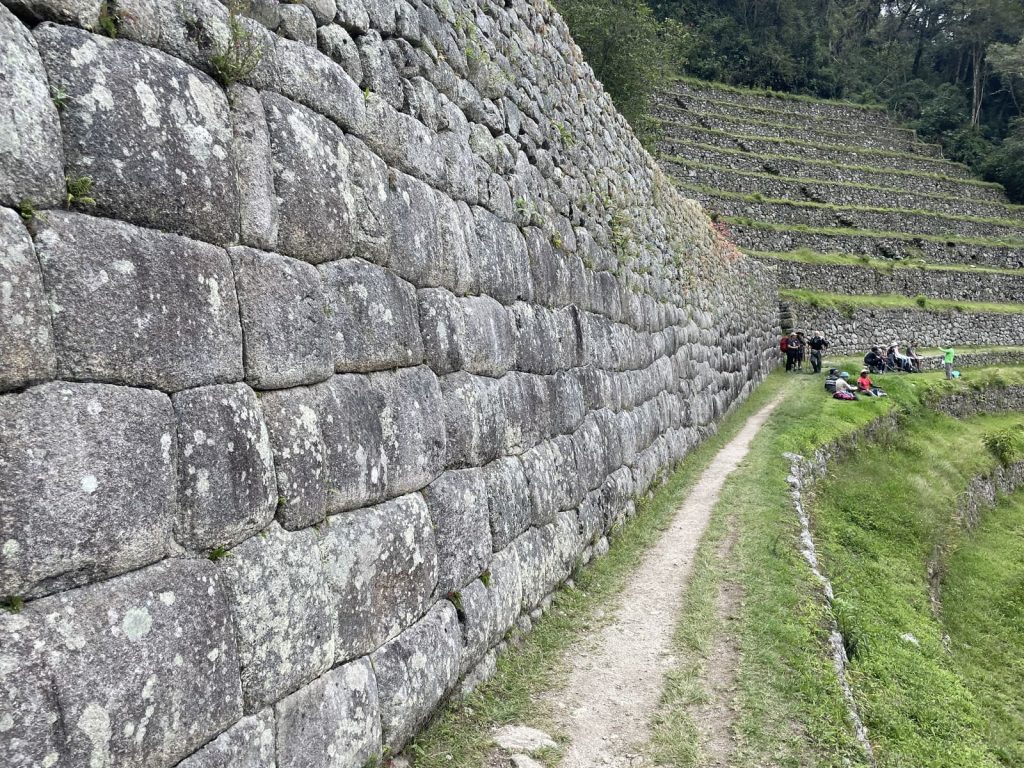
This plan gets you ready for the classic 4-day Inca Trail in 12 weeks. It is built around what the trail actually asks of you: a climb of about 1,200 m on stone steps to Dead Woman’s Pass (4,215 m) on Day 2, and long descents on stone staircases on Days 2 and 3. You need four or five sessions a week, five to eight hours in total, and no gym: stairs, a hill and a daypack do most of the work.
Not sure where you are starting from? Take the self-test in How fit do you need to be for the Inca Trail? first. If you passed six or more of the tests, start this plan at Week 5. If you passed four or fewer, do all 12 weeks, and if you don’t exercise at all at the moment, walk three or four times a week for a month before Week 1. If you have a heart or lung condition or joint problems, check with your doctor before you start.
We have run Inca Trail treks since 2006. For the route, permits and packing, see our Inca Trail guide.
What you are training for
- Day 1: 11 km in 5–6 hours, gently uphill from 2,700 m to about 3,000 m.
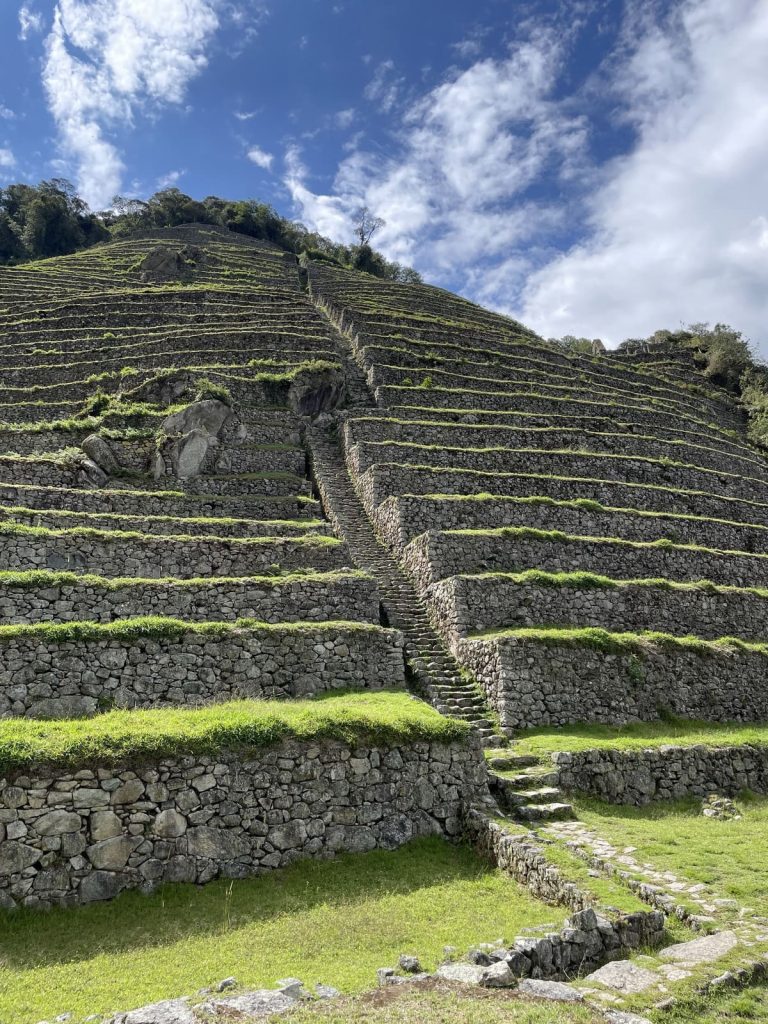
- Day 2: 11 km in 7–9 hours: about 1,200 m up to Dead Woman’s Pass, then about 600 m down steep steps.
- Day 3: 16 km in 8–10 hours, over two more passes and down a long staircase to Wiñay Wayna.
- Day 4: 4 km in about 2 hours to the Sun Gate and Machu Picchu.
The climbs leave you breathless, but the descents do the damage. Walking down steps makes your thigh muscles work while they lengthen, which is what causes the soreness most trekkers feel by Day 3. That is why this plan trains descents on purpose, not just climbs. For the metres up and down on each day, see Inca Trail difficulty, day by day.
Know what you will carry, too. On our tours the porters carry the tents, kitchen and food; you carry your own things, including your sleeping bag and clothes, unless you add an extra porter load (5 kg) when you book our Inca Trail tour. Pack your bag early, weigh it, and train with that weight.
How the 12 weeks work
- Cardio: three or four sessions a week of 30 to 75 minutes: walking, hill walking, cycling, swimming or stairs.
- Strength: two sessions a week of 30 to 40 minutes, at home.
- Weekend hike: one a week, getting longer; in Weeks 10 and 11, two days in a row.
- Rest: at least one full rest day a week, and two in the first month.
- Progression: add no more than about 10% to your weekly walking at a time, and ease off for a week if anything hurts.
Weeks 1–4: build a base
The goal is a routine your body can absorb without soreness or injury. Keep every session at a pace where you can talk.
- Cardio: three or four sessions of 30–45 minutes of brisk walking, easy cycling or swimming.
- Strength, twice a week: bodyweight squats (3 × 12–15), lunges (3 × 10 on each leg), step-ups onto a 40 cm step (3 × 10 on each leg), calf raises on the edge of a step (3 × 15–20) and a plank (3 × 30–45 seconds).
- Weekend walk: 5 km (3 miles) on the flat in Week 1, building to 10 km (6 miles) with about 200 m (650 ft) of climbing by Week 4. Carry only water.
- Boots: if they are new, wear them around the house, then on your short walks.
Weeks 5–8: add hills, stairs and a pack
Now the training starts to look like the trail. Put on a daypack with 2–3 kg in Week 5 and work up to 4–5 kg by Week 8.
- Cardio: four sessions of 45–60 minutes. Once a week, do hill repeats: find a hill that takes two or three minutes to climb, walk up at a hard but steady effort, walk down slowly, and repeat four to six times.
- Stairs, once a week: 30 flights in Week 5 (a flight is 10–12 steps), building to 60 by Week 8. Climb at a steady pace and come down under control; the way down is the half that matters most.
- Strength, twice a week: step-ups with your daypack (3 × 10 on each leg), split squats with your back foot on a bench (3 × 8–10 on each leg), slow step-downs from a knee-high step (3 × 12 on each leg), single-leg calf raises (3 × 12–15) and a plank (3 × 45–60 seconds).
- Weekend hike: 11 km (7 miles) with 300 m (1,000 ft) of climbing in Week 5, building to 16 km (10 miles) with 550 m (1,800 ft) by Week 8.
Weeks 9–11: rehearse the trek
This is the hardest block. From Week 9 carry the full weight you will have on the trail.
- Cardio: four sessions of 60–75 minutes, including one hill-repeat session.
- Stairs, once a week: 75 flights in Week 9, building to 100 with your pack by Week 11.
- Strength, twice a week: the same exercises as Weeks 5–8, a little heavier but with fewer repetitions, so they don’t leave you tired for the weekend.
- Week 9 hike: 18 km (11 miles) with 600 m (2,000 ft) of climbing.
- Week 10 hikes: two days in a row, about 16 km on Saturday and 12 km on Sunday. Notice how your legs feel on the second day: that is the Inca Trail.
- Week 11, the test hike: 20 km (12 miles) with about 750 m (2,500 ft) of climbing, with your full pack. If you finish tired but fine, and could have walked again the next day, you are ready. If you struggled badly, repeat Week 10 and push your trek back if you can.
Week 12: ease off
Cut your training by about half. The fitness you have built stays; the tiredness goes.
- Two or three short, easy sessions of 30–45 minutes.
- One easy 10 km walk with your packed bag 7 to 10 days before you fly, to check that your boots, pack and poles work together.
- No strength training in the final week, and your last session two or three days before you fly. The flights and the first days at altitude will tire you enough.
The five exercises that matter most
- Stairs with a pack. The closest thing to the trail you can do at home: it trains the climb, the descent and carrying your pack at once. Take the stairs two at a time now and then, because many Inca steps are high.
- Step-downs. Stand on a knee-high step, lower one foot slowly to the floor, touch lightly and stand back up. This trains exactly the control you need on the descents.
- Step-ups. Onto a bench or step 40–50 cm high, driving through the heel, first without weight and then with your pack.
- Hill repeats. Short, hard climbs build the heart and legs for the long climb to Dead Woman’s Pass.
- Plank. A strong core keeps you upright and steady with a pack on uneven stone. Once 60 seconds is easy, do it wearing your pack.
Altitude: what training can and can’t do
Training at home can’t acclimatise you to altitude; only time at altitude does that. What training does is make hard effort feel more manageable when there is less oxygen. From Week 5, make one cardio session a week an interval session: four rounds of four minutes at a hard effort and three minutes easy.
The rest happens in Peru. Spend at least two nights in Cusco (3,400 m) or the Sacred Valley before the trek, take the first day easy, drink plenty and go easy on alcohol. If you have had altitude sickness before, ask your doctor about acetazolamide (Diamox). Our guide to how fit you need to be explains what altitude does on Day 2, and our Inca Trail guide covers how guides handle it on the trail.
Boots, poles and your pack
- Boots: new boots need several weeks to soften. Wear them at home in Weeks 1–2, on short walks in Weeks 3–4 and on every hike from Week 5. If they still give you hot spots by Week 8, change them rather than hope they improve.
- Poles: they take a lot of the strain off your knees on the descents. Practise with them from Week 5: set them so your elbows bend at a right angle on the flat, shorten them a little for climbs and lengthen them for descents. Fit rubber tips before the trek: metal tips damage the Inca stones, and the trail rules require them.
- Pack: use the pack you will trek with, with the hip belt on your hip bones taking most of the weight. Add weight step by step, as set out above, until you are carrying your trek weight from Week 9.
Staying injury-free
- Start every session with five minutes of easy walking and a few leg swings, and finish with a few minutes of stretching.
- Muscle soreness a day or two after a hard hike is normal. Sharp pain, joint pain or pain that gets worse as you walk is not: ease off, and see a physiotherapist if it lasts more than a few days.
- If you miss a week, don’t try to catch up. Repeat the last week you completed and carry on from there.
- Sleep and eat properly. You are asking your body to do more each week, and it recovers at rest.