
Salar de Uyuni guide: Bolivia’s salt flats
Standing at the edge of Salar de Uyuni feels like stepping onto another planet. The world’s largest salt flat stretches 10,582 square kilometers across southwestern Bolivia, creating a blinding white expanse where earth and sky merge into infinity.
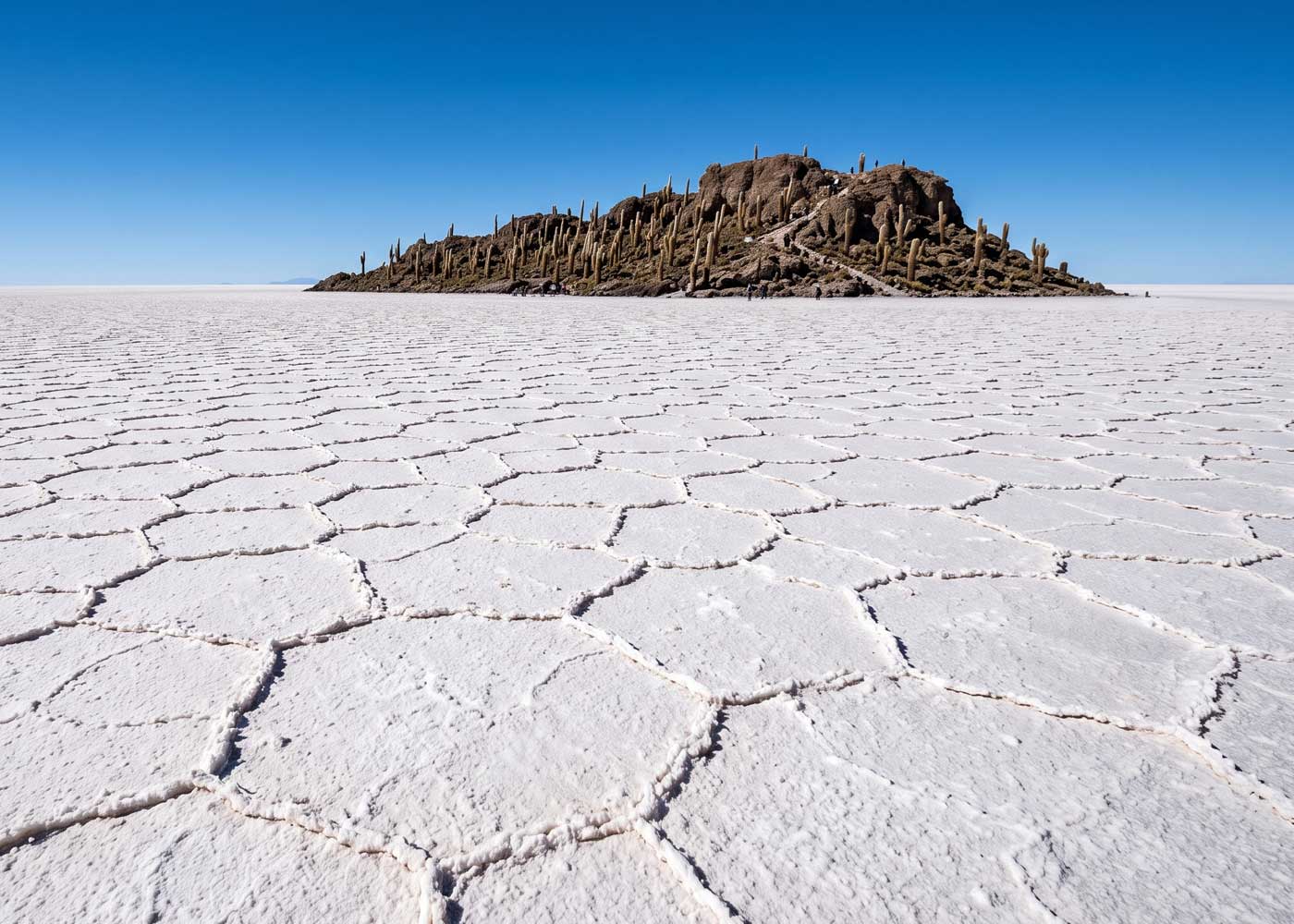
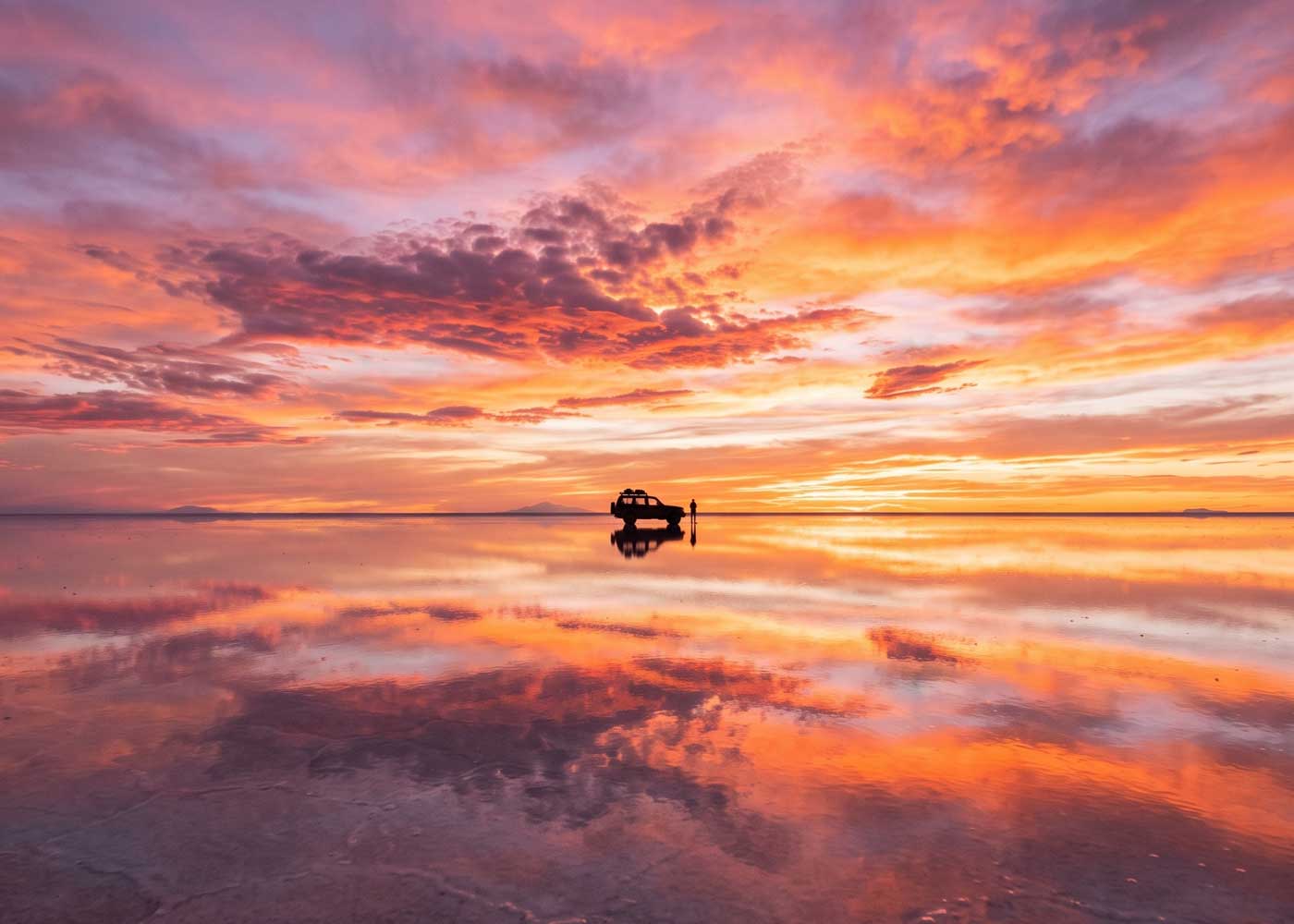
During the wet season, a thin layer of water transforms this prehistoric lakebed into the world’s largest natural mirror. During the dry season, hexagonal salt patterns stretch to every horizon like geometric art sculpted by nature.
This guide covers everything you need to plan your Salar de Uyuni trip: when to visit for your photography goals, which tour length matches your interests, how to manage the altitude, and what to pack for temperature swings that can hit 30 degrees Celsius in a single day. Many travelers combine the salt flats with a Peru itinerary around Cusco and Machu Picchu, since La Paz and Cusco are a short flight apart.
What Is Salar de Uyuni?
Salar de Uyuni is a 10,582-square-kilometer salt flat in southwestern Bolivia, formed roughly 40,000 years ago from the evaporation of prehistoric Lake Minchin, and it is the largest salt flat on Earth.
The salt crust averages 10 meters thick and sits at 3,656 meters elevation on the Altiplano plateau. During Bolivia’s wet season (December through April), a thin layer of rainwater turns the surface into the world’s largest natural mirror. During the dry season, the crust dries into distinctive hexagonal patterns. Beneath the salt lies an estimated 50-70% of the world’s known lithium reserves (source: USGS Mineral Commodity Summaries), making the site both a tourism landmark and a geopolitically significant mineral deposit.
The surrounding Eduardo Avaroa National Reserve, which most multi-day tours pass through, is administered by SERNAP, Bolivia’s national protected-areas service.
Why Salar de Uyuni Deserves a Spot on Your Bucket List
The Scale: 10,582 Square Kilometers of Salt
Salar de Uyuni covers more area than the island of Puerto Rico. At its widest point, the salt flat spans 129 kilometers. When you stand at its center, the curvature of the Earth becomes visible because the terrain is so extraordinarily flat.
This flatness results from the salt crust’s thickness, which averages 10 meters and reaches 120 meters in some areas. Beneath the surface lies an estimated 10 billion tons of salt, along with significant lithium deposits that represent roughly 50-70% of the world’s known reserves (source: USGS Mineral Commodity Summaries).
The Mirror Effect: Walking on Sky
The phenomenon that draws photographers from every continent occurs during Bolivia’s wet season (December through April). Rainfall collects on the salt crust, creating a water layer just centimeters deep that transforms the flats into a perfect mirror.
When conditions align, the reflection is so precise that horizon lines disappear completely. Clouds appear both above and below you. People photograph themselves seemingly walking through the sky or standing on clouds.
The effect works best in the early morning before wind disturbs the water surface. Even a light breeze creates ripples that fragment reflections.
As a rule of thumb, there is roughly a 90-minute window after sunrise before the wind picks up. The water needs to be shallow enough to reflect but deep enough not to show the salt crust underneath, with two to three centimeters being the sweet spot.
The Perspective Photos: Playing with Reality
The salt flat’s uniform white surface eliminates all visual reference points for distance and scale. This creates perfect conditions for forced perspective photography, where carefully positioned subjects appear to interact with objects that are actually far away.
Classic Uyuni perspective shots include people standing in the palm of a giant hand, emerging from a Pringles can, or being chased by toy dinosaurs. Tour guides have mastered these setups and carry props ranging from wine bottles to plastic figurines.
The technical key is positioning: subjects near the camera appear large, while distant subjects appear small. The flat, featureless background provides no contradicting depth cues.
Geological Wonder: 40,000 Years in the Making
Salar de Uyuni began as part of a giant prehistoric lake called Lake Minchin, which covered much of southwestern Bolivia approximately 40,000 years ago (Placzek et al., Quaternary Research, 2006). As the climate dried, this ancient body of water evaporated and separated into several smaller lakes.
The salt flat represents the largest remnant of Lake Minchin’s lakebed. Ongoing evaporation concentrated the dissolved minerals, leaving behind the thick salt crust visible today. The process continues: rainwater dissolves surface salt during the wet season, then evaporates and redeposits it as the dry season progresses.
What makes Uyuni unusual among salt flats worldwide is the thickness and uniformity of the crust. Most salt pans crack unevenly, but Uyuni’s seasonal flooding acts as a self-leveling mechanism that has maintained its flatness for millennia.
When to Visit Salar de Uyuni: Choosing Your Experience
Your ideal visit timing depends on what you want to photograph and how much accessibility matters.
Dry Season (May-October): Hexagon Patterns and Clear Skies
The dry season offers the most reliable touring conditions. Roads across the salt remain passable, allowing access to remote areas including Isla Incahuasi at the flat’s center.
During these months, the salt surface dries into distinctive hexagonal patterns. These geometric shapes form as the salt crystallizes during evaporation, creating natural tessellations that stretch toward every horizon.
Dry season advantages:
- Reliable access to all areas
- Consistent tour departures
- Hexagonal pattern photography
- Better conditions for sunrise/sunset shoots
- Less cold at night (though still cold)
Dry season considerations:
- No mirror effect
- More tourist traffic (June-August peak)
- Dustier conditions
Temperature ranges (dry season):
- Daytime: 13-21C (55-70F)
- Nighttime: -10 to 5C (14-41F)
Wet Season (December-April): The Famous Mirror Effect
The rainy season brings the mirror effect that dominates Salar de Uyuni imagery worldwide. However, wet season visits require flexibility and realistic expectations.
Not every day produces mirror conditions. Heavy rainfall can flood areas beyond safe passage. Some tour routes become impassable. The most reliable mirror conditions typically occur in February and March when rainfall moderates.
Wet season advantages:
- Mirror effect possibility
- Fewer tourists
- Greener landscapes in surrounding areas
- More flamingos at lagoons
Wet season considerations:
- Tours may be canceled or modified
- Some areas inaccessible
- Colder nights (as low as -15C)
- Less predictable scheduling
Temperature ranges (wet season):
- Daytime: 10-18C (50-64F)
- Nighttime: -15 to 0C (5-32F)
Shoulder Months: November and Early December
November offers a middle ground. Early rains may produce partial flooding suitable for reflections, while many areas remain accessible. This shoulder period sees fewer visitors than dry season peaks.
Early December continues this pattern, though rainfall intensity increases as the month progresses.
Which season is better depends on what you want. Dry season gives you the hexagons and the stars at night. Wet season gives you the mirror, but you have to be patient: some days the water is too deep, some days there is no water. February is the most reliable for reflections, but July is the most reliable for everything else.
Month-by-Month Breakdown
| Month | Conditions | Mirror Potential | Accessibility | Crowds |
|---|---|---|---|---|
| January | Peak wet | High | Limited | Low |
| February | Peak wet | Highest | Limited | Low |
| March | Late wet | High | Moderate | Low |
| April | Transition | Moderate | Improving | Low |
| May | Early dry | Low | Good | Moderate |
| June | Dry | None | Excellent | High |
| July | Dry | None | Excellent | Highest |
| August | Dry | None | Excellent | High |
| September | Dry | None | Excellent | Moderate |
| October | Late dry | None | Excellent | Moderate |
| November | Transition | Low-Moderate | Good | Low |
| December | Early wet | Moderate | Variable | Moderate |
Salar de Uyuni Tours: Finding the Right Trip Length
Nearly all visitors experience Salar de Uyuni through organized tours. The terrain, distances, and lack of infrastructure make independent exploration impractical for most travelers.
1-Day Tours: Salt Flats Highlights
A single-day tour covers the most iconic Salar de Uyuni locations without venturing into the broader region. These tours depart Uyuni town in the morning and return by evening.
Typical 1-day itinerary:
- Train Cemetery (Cementerio de Trenes)
- Colchani salt processing village
- Salt flats with perspective photo session
- Isla Incahuasi (cactus-covered island)
- Sunset viewing on the flats
Duration: 10-12 hours
Price range: $30-60 per person (group tour)
Best for: Travelers with limited time or those who have seen similar landscapes elsewhere
1-day tour limitations:
- No colored lagoons
- No geysers
- No Eduardo Avaroa National Reserve
- Rushed pacing
3-Day Tours: The Classic Uyuni Experience
The three-day tour represents the most popular option, combining the salt flats with the stunning landscapes of Eduardo Avaroa National Reserve. This route can end in Uyuni or continue to San Pedro de Atacama, Chile.
Day 1: Train Cemetery, Colchani village, Salt flats and Isla Incahuasi, Overnight near Chiguana
Day 2: Siloli Desert, Arbol de Piedra (Stone Tree), Laguna Colorada with flamingos, Overnight near lagoon
Day 3: Sol de Manana Geysers (5am start), Hot springs, Laguna Verde, Return to Uyuni or Chile border
Duration: 3 days / 2 nights
Price range: $150-280 per person (group tour)
Best for: First-time visitors wanting full coverage
4-Day Tours: Extended Exploration
Four-day tours add time for additional stops and more relaxed pacing. The extra day typically includes either extended time at the salt flats or additional lagoons and geological formations.
Additional inclusions may feature:
- Tunupa Volcano visit
- Additional colored lagoons
- More photography time at key locations
- Cave paintings near Coquesa
- Extended time at Sol de Manana
Duration: 4 days / 3 nights
Price range: $200-350 per person (group tour)
Best for: Photography enthusiasts, those wanting thorough coverage
Private vs Group Tours
Group tours (4-7 people per vehicle): Lower cost, social experience, fixed itineraries, scheduled departure times, shared decision-making on stops.
Private tours (your group only): Flexible itineraries, photography-focused pacing available, departure time control, higher cost (2-3x group rate), better for families with children.
How to Book a Salar de Uyuni Tour
- Choose your season. Decide whether you want the mirror effect (December-April) or reliable dry-season access with hexagonal patterns (May-October). This determines your travel dates.
- Pick a tour length. One-day tours cover the salt flats only. Three-day tours add colored lagoons, geysers, and Eduardo Avaroa National Reserve. Four-day tours add relaxed pacing and extra stops.
- Decide group or private. Group tours (4-7 people, $150-280 for 3 days) cost less but follow fixed schedules. Private tours (2-3x the price) offer flexible timing and photography-focused pacing.
- Book through a local operator in Uyuni or online in advance. Booking in Uyuni town gives you leverage to inspect vehicles and negotiate, but high-season tours (June-August) sell out. Booking online in advance guarantees your spot.
- Arrange transport to Uyuni. Fly from La Paz (45 minutes, $80-150) or take an overnight bus (10-12 hours, $12-22). Allow a buffer day for altitude adjustment before your tour starts.
- Confirm inclusions before paying. Verify that meals, accommodation, park entrance fees, and border-crossing logistics (if ending in Chile) are included. Ask about vehicle condition and group size.
Booking Tips and Scam Avoidance
Uyuni’s tour market is largely unregulated, and street-side booking carries real risk. The most commonly reported problems are itineraries changed after payment, guides advertised as English-speaking who turn out not to be, and the vehicle swapped for an older model on departure day.
Reputable operators with a long track record and verifiable reviews are worth the extra research time. A noticeably cheap price often means an older vehicle, a driver working back-to-back trips without adequate rest, or corners cut on meals and equipment, all of which matter more on remote desert routes with no cell signal for long stretches.
- Read recent reviews before paying, not just the operator’s own testimonials
- Ask specifically about vehicle age, driver rest schedules, and group size
- Get the full itinerary and inclusions in writing before transferring payment
- Booking through a known agency or in advance online reduces exposure to street-level scams versus booking cold in Uyuni town
Highlights of the Salar de Uyuni Region
Salar de Uyuni Salt Flats
The salt flat itself delivers the most surreal moments of any Bolivia trip. During sunrise and sunset, the white surface glows pink, orange, and gold. At midday, the brightness can be overwhelming without proper eye protection.
The flattest areas lie toward the center, where elevation variation across 50 kilometers measures less than one meter. This extraordinary flatness makes the salt flats useful for satellite calibration.
Coordinates: 20.1338S, 67.4891W
Best time of day: Sunrise and sunset for photography; midday for mirror effect during wet season
Isla Incahuasi (Fish Island)
Rising from the salt flat’s center, Isla Incahuasi is actually the peak of an ancient volcano submerged in the prehistoric lake. The island’s name means “house of the Inca” in Quechua, though the site predates Inca civilization.
Giant Trichocereus cacti cover the rocky outcrop, some reaching over 10 meters tall and estimated at 1,200 years old. A trail loops around and over the island, offering 360-degree views across the salt flats.
Coordinates: 20.2406S, 67.6250W
Entrance fee: 30 Bolivianos ($4-5)
Time needed: 30-60 minutes
Train Cemetery (Cementerio de Trenes)
Three kilometers outside Uyuni town, rusting steam locomotives and rail cars litter the desert landscape. These British-built trains served Bolivia’s mining industry from the late 1800s until the 1940s, when mineral deposits depleted and indigenous communities sabotaged tracks in land disputes.
The cemetery holds roughly 100 vehicles in various states of decay. Morning light creates the most dramatic photography conditions.
Coordinates: 20.4658S, 66.8310W
Time needed: 20-40 minutes
Eduardo Avaroa National Reserve
This 714,745-hectare reserve protects the volcanic landscapes, colored lagoons, and wildlife of Bolivia’s extreme southwest corner. Three-day and four-day tours spend most of their time within reserve boundaries.
Key features:
- Multiple colored lagoons
- Active geothermal areas
- James’s flamingo breeding grounds
- Volcanic peaks exceeding 5,000 meters
- Desert landscapes at 4,200-4,800 meters elevation
Reserve entrance fee: 150 Bolivianos ($20-22)
Laguna Colorada (Red Lagoon)
This shallow salt lake’s striking red coloration comes from algae and plankton that thrive in its mineral-rich waters. The red waters contrast dramatically with white borax deposits along the shoreline.
The lagoon hosts thousands of flamingos, including the rare James’s flamingo found only in the high Andes. Bird populations peak during breeding season (November through January).
Coordinates: 22.1997S, 67.7573W
Elevation: 4,278 meters
Best viewing: Morning when flamingos feed near shore
Laguna Verde (Green Lagoon)
Near the Chilean border, Laguna Verde displays emerald-green coloration caused by high concentrations of lead, sulfur, and arsenic. The coloration intensifies when afternoon winds agitate the water surface.
Licancabur Volcano (5,916m) rises behind the lagoon, creating one of Bolivia’s most photographed scenes.
Coordinates: 22.7835S, 67.8141W
Elevation: 4,329 meters
Best viewing: Afternoon when wind activates colors
Sol de Manana Geysers
At 4,850 meters elevation, this geothermal field features bubbling mud pools, steaming fumaroles, and sulfur-encrusted vents. Tours arrive at dawn to witness steam plumes in the cold morning air.
The area lacks developed infrastructure. Visitors walk freely among geothermal features, which requires caution around scalding mud pools and unstable ground.
Coordinates: 22.4333S, 67.6333W
Elevation: 4,850 meters
Best viewing: Early morning (5-7am) for dramatic steam effects
Arbol de Piedra (Stone Tree)
Wind erosion carved this 5-meter rock formation into a shape resembling a tree. The soft volcanic rock eroded faster at ground level, where sand-carrying winds concentrated their abrasive force.
The stone tree sits amid the Siloli Desert, surrounded by similar but less dramatically shaped rock formations.
Coordinates: 22.4553S, 67.5958W
How to Get to Salar de Uyuni
Flying to Uyuni (Joya Andina Airport)
Direct flights connect Uyuni with La Paz, making this the fastest arrival option. The small Joya Andina Airport sits just outside town.
Airlines: Amaszonas (primary), Boliviana de Aviacion
Flight time from La Paz: 45 minutes
Frequency: 1-2 flights daily (more during high season)
Price: $80-150 one-way
Airport notes:
- No ATMs at airport
- Limited services
- Taxis to town: 20 Bolivianos
- Altitude on arrival: 3,669 meters
Bus from La Paz (10-12 Hours)
Overnight buses from La Paz to Uyuni depart nightly, arriving early morning. The route passes through Oruro before turning south across the altiplano.
Recommended companies: Todo Turismo, Panasur, Trans Omar
Departure time: Usually 8-9pm
Arrival time: 6-8am
Price: 80-150 Bolivianos ($12-22) depending on bus class
Comfort: Semi-cama (partially reclining) or cama (fully reclining) recommended
Bus travel tips:
- Book semi-cama or cama class for sleep
- Bring warm layers (buses can be cold)
- Carry snacks and water
- Confirm departure point (terminals vary by company)
Bus from Sucre, Potosi, or Tupiza
From Sucre: 9-10 hours, morning and evening departures, 70-100 Bolivianos, routed via Potosi.
From Potosi: 4-5 hours, multiple daily departures, 40-60 Bolivianos.
From Tupiza: Some operators also run multi-day 4×4 tours starting in Tupiza rather than Uyuni, giving southern-route travelers an alternative entry point into the same reserve circuit.
Potosi makes a logical stopover, allowing altitude acclimatization while visiting the historic mining city.
Crossing from San Pedro de Atacama, Chile
Many travelers combine Uyuni with Chile’s Atacama Desert. Three-day tours can start in either direction, crossing the border at Hito Cajon.
Border crossing notes:
- Chilean side: Straightforward immigration
- Bolivian side: Basic facilities, possible delays
- Crossing typically included in tour price
- Bring passport (obviously)
- Declare any food items
Important: Some nationalities require Bolivian visas. US citizens pay a reciprocity fee ($160 as of 2026) at the border.
Tour Transfers
Most tour operators offer transfers from La Paz or Sucre as add-on services. These private or shared van transfers deliver you to Uyuni with less hassle than public buses.
La Paz to Uyuni transfer: $40-80 per person (shared)
Sucre to Uyuni transfer: $30-50 per person (shared)
Where to Stay: Uyuni Town and Salt Hotels
Uyuni Town Hotels (Budget to Mid-Range)
Uyuni itself is a functional rather than charming town. Most visitors spend only one night before or after their salt flat tour. Hotels cluster around the main plaza and along Avenida Ferroviaria.
Budget options ($10-25):
- Basic rooms with shared bathrooms
- Hot water availability varies
- Breakfast rarely included
- Adequate for one-night stays
Mid-range options ($40-80):
- Private bathrooms with reliable hot water
- Heating in rooms (important at 3,656m)
- Breakfast included
- Better mattresses and blankets
Recommended mid-range properties: Hotel de Sal Luna Salada (closest to flats), Hotel Jardines de Uyuni (central, reliable), Hotel Tambo Aymara (good value).
Salt Hotels: The Unique Experience
Several hotels constructed entirely from salt blocks offer unique accommodation on or near the Bolivia salt flats. Walls, floors, furniture, and even beds use salt harvested from Salar de Uyuni.
Salt hotel experience:
- Walls, furniture, and decorations made from salt
- Typically 30-60 minutes from Uyuni town
- Stunning salt flat views
- Higher price point justified by novelty
Price range: $150-400 per night
Best properties: Palacio de Sal (original salt hotel), Luna Salada Hotel, Cristal Samana
Salt hotel reality check: The experience is genuinely unique, but rooms can be cold (salt is a poor insulator), and the remote location means limited restaurant and activity options.
Accommodation During Multi-Day Tours
Standard multi-day tours include basic accommodation in refugios (simple shelters) along the route. Expect shared rooms, minimal heating, basic bathrooms, and cold nights.
Typical refugio features:
- 4-8 beds per room
- Shared bathrooms (sometimes outdoor)
- Dining area with included meals
- Limited or no electricity
- Very cold at night (bring warm sleeping layers)
Upgrade options: Some tour operators offer higher-tier accommodation with private rooms and better facilities for additional cost. Discuss options when booking.
Essential Packing List for Salar de Uyuni
Clothing for Extreme Temperature Swings
Temperature at Salar de Uyuni can swing 30+ degrees Celsius between midday and pre-dawn. Layering is essential.
Base layers: Thermal underwear (top and bottom), moisture-wicking t-shirts, warm socks (multiple pairs).
Mid layers: Fleece jacket or vest, down jacket or insulated layer, long pants (convertible hiking pants work well).
Outer layers: Windproof and waterproof jacket, hat or beanie for cold mornings, gloves (essential for sunrise shoots).
Footwear: Sturdy walking shoes or boots, sandals for hot springs (if on multi-day tour), extra socks.
Sun Protection Essentials
The altitude (3,656m+) and reflective white surface create extreme UV exposure. Sunburn happens rapidly without protection.
- Sunscreen SPF 50+ (apply frequently)
- UV-blocking sunglasses (polarized ideal)
- Wide-brimmed hat or cap with neck protection
- Lip balm with SPF
- Long-sleeved shirt for midday
Warning: Standard sunglasses are insufficient. The salt’s reflectivity means UV hits from below as well as above. Quality polarized lenses significantly improve comfort and vision.
Photography Gear
Camera equipment: Camera with manual exposure control, wide-angle lens (essential for landscapes), tripod (required for night shots and long exposures), extra batteries (cold drains batteries quickly), memory cards (you will shoot more than expected).
Protection: Camera bag or protective sleeve, lens cleaning kit, plastic bags for salt and dust protection, microfiber cloths.
Health and Safety Items
Altitude management: Acetazolamide (Diamox) if prescribed by doctor, ibuprofen for headaches, coca leaves or coca candy (available locally), electrolyte tablets.
General health: Personal medications, basic first aid supplies, hand sanitizer, tissues, toilet paper (not always provided).
Other essentials: Headlamp or flashlight, reusable water bottle, snacks (tour food can be basic), cash in Bolivianos (ATMs unreliable in Uyuni), passport and copies.
Salar de Uyuni Photography: Capturing the Magic
Mirror Effect Photography Tips
The mirror effect requires specific conditions: still water and diffused light.
Optimal conditions: Early morning before wind develops, overcast sky for even lighting, water depth of 1-5 centimeters, no recent heavy rain (too deep).
Technical settings: Low ISO (100-400), small aperture (f/8-f/11) for depth, shutter speed as needed for exposure, focus on the horizon line or subject.
Composition approaches: Place horizon at center for symmetry, include a subject for scale, shoot low to maximize reflection, frame clouds for dramatic effect.
Perspective Photo Techniques
Setup requirements: Two distinct planes with foreground subject and background object. Distance creates size illusion. White background eliminates reference points.
Common setups: Large object far (20-50 meters), small subject near (2-3 meters); subjects appear to interact with distant objects; props enhance creativity (dinosaurs, bottles, shoes).
Technical approach: Small aperture (f/16-f/22) for full depth of field, focus approximately one-third into scene, position camera low for better alignment, direct subjects precisely (inches matter).
Best Times of Day for Shooting
- Sunrise (6-7am): Dramatic colors on white surface, long shadows for texture, cold but magical light, mirror effect best before wind
- Midday (11am-2pm): Harsh light and difficult exposure, but best for mirror effect in wet season; bring a UV filter for the lens
- Sunset (5-7pm depending on season): Golden light transforms salt pink/orange, warm tones, long shadows, popular with tours (crowds possible)
- Night (9pm-3am): Milky Way visible in dark skies, requires tripod and long exposure skills, best during new moon phases, extremely cold
Night Sky and Milky Way Photography
The salt flats’ remoteness and thin atmosphere at altitude create exceptional conditions for astrophotography.
Equipment needs: Tripod (essential), wide-angle lens (f/2.8 or faster ideal), remote shutter release, headlamp with red light option.
Settings guidance: ISO 3200-6400, aperture wide open, shutter 15-30 seconds (longer causes star trails), manual focus set to infinity.
Milky Way visibility: Best March through October, core position varies by month, new moon essential, galaxy rises in the southeast.
Protecting Your Gear from Salt
Salt corrodes metal and scratches glass. Active protection extends equipment life.
- Keep camera in bag when not shooting
- Use UV or protective filter on lens
- Wipe equipment with damp cloth after each session
- Avoid changing lenses in windy conditions
- Store batteries inside jacket (warmth extends life)
- Check for salt residue on tripod legs daily
Managing Altitude at Salar de Uyuni (3,656m)
Understanding High Altitude Effects
Uyuni sits at 3,656 meters (11,995 feet). Multi-day tours climb higher, reaching 4,850 meters at Sol de Manana Geysers. At these elevations, reduced oxygen affects most visitors to some degree.
Common symptoms: Headache, shortness of breath with exertion, difficulty sleeping, reduced appetite, mild nausea.
Risk factors: Rapid ascent (flying directly to Uyuni), physical exertion before acclimatization, dehydration, alcohol consumption, previous altitude sickness history.
Acclimatization Strategies
Before arrival: Consider spending 2-3 nights in La Paz (3,640m) first; Sucre (2,810m) offers gentler acclimatization; avoid flying directly from sea level to Uyuni.
During visit: Minimize physical exertion on first day, drink 3-4 liters of water daily, avoid alcohol for first 48 hours, eat light carbohydrate-rich meals, rest when symptoms appear.
Coca: Coca tea (mate de coca) is traditional and widely available; coca candy provides a similar mild effect; it is legal in Bolivia and helps many visitors, though it is not a substitute for proper acclimatization.
Medication: Acetazolamide (Diamox) can prevent or reduce symptoms; it requires a prescription in most countries; start 24-48 hours before altitude exposure and discuss with a doctor before travel.
When to Seek Medical Help
Most altitude symptoms resolve with rest and time. However, severe acute mountain sickness requires immediate descent and medical attention.
Seek help if experiencing: Severe persistent headache not relieved by medication, confusion or disorientation, loss of coordination (ataxia), persistent vomiting, chest tightness or fluid sounds when breathing, bluish skin color.
Emergency response: Descend immediately if symptoms are severe; supplemental oxygen helps if available; Uyuni has a basic hospital; the nearest major medical facilities are in Sucre or La Paz.
Building Your Bolivia Itinerary Around Uyuni
La Paz + Uyuni (7-10 Days)
This classic combination works for most first-time Bolivia visitors.
- Days 1-2: La Paz arrival and acclimatization
- Day 3: Death Road cycling or Valley of the Moon
- Day 4: Flight or overnight bus to Uyuni
- Days 5-7: 3-day salt flats tour
- Days 8-9: Return to La Paz, additional sightseeing
- Day 10: Departure
Transportation: Fly or bus between La Paz and Uyuni.
Uyuni + San Pedro de Atacama (Chile Circuit)
Combining Bolivia’s salt flats with Chile’s Atacama Desert creates a world-class landscape circuit.
- Days 1-2: La Paz acclimatization
- Day 3: Fly to Uyuni
- Days 4-6: 3-day tour ending at the Chile border
- Days 6-8: San Pedro de Atacama exploration
- Day 9: Fly from Calama to Santiago
Key note: This route crosses the border during the tour, ending in Chile. Confirm visa requirements for both countries before booking.
Full Bolivia Loop (14-21 Days)
For full Bolivia exploration, combine Uyuni with the country’s diverse regions.
- Days 1-3: La Paz and surroundings
- Day 4: Bus to Sucre
- Days 5-6: Sucre (colonial architecture, dinosaur tracks)
- Day 7: Bus to Potosi
- Day 8: Potosi (Cerro Rico mine tour)
- Day 9: Bus to Uyuni
- Days 10-12: 3-day salt flats tour
- Day 13: Fly or bus to La Paz
- Day 14: Departure
Extended options (add 5-7 days): Lake Titicaca and Copacabana, Rurrenabaque and Amazon basin, Tupiza and southern canyons.
Combining Bolivia with Peru
Travelers building a longer South America trip often pair Salar de Uyuni with Peru’s Inca Trail and Machu Picchu, since La Paz and Cusco connect by direct flight. A common sequence runs Uyuni first for the altitude and landscapes, then flies to Cusco for Machu Picchu and the Sacred Valley, using the acclimatization already gained on the Altiplano.
Salar de Uyuni Costs: Budget Breakdown for 2026
Tour Costs by Type
| Tour Type | Group Tour | Private Tour |
|---|---|---|
| 1-day | $30-60 | $150-250 |
| 3-day | $150-280 | $500-800 |
| 4-day | $200-350 | $700-1,000 |
Tour typically includes:
- Transportation in 4×4 vehicle
- Driver/guide
- Accommodation (multi-day)
- All meals (multi-day)
- Park entrance fees
Tour typically excludes:
- Isla Incahuasi entrance (30 Bs)
- Drinks and snacks
- Tips for guide/driver
- Sleeping bag rental (if needed)
Accommodation Costs
| Type | Price per Night |
|---|---|
| Budget hostel (shared) | $10-15 |
| Budget hotel (private) | $20-35 |
| Mid-range hotel | $40-80 |
| Salt hotel | $150-400 |
Food and Extras
| Item | Typical Cost |
|---|---|
| Restaurant meal in Uyuni | $5-10 |
| Market food | $2-4 |
| Water (1.5L bottle) | $1 |
| Sleeping bag rental | $5-10/night |
| Guide tip (3-day tour) | $10-20 per person |
| Driver tip (3-day tour) | $10-20 per person |
Sample Budgets
Budget traveler (3-day tour):
Bus La Paz-Uyuni: $15
3-day group tour: $170
1 night Uyuni (budget): $20
Food/extras: $30
Total: ~$235
Mid-range traveler (3-day tour):
Flight La Paz-Uyuni: $120
3-day group tour: $220
1 night Uyuni (mid-range): $60
Food/extras: $50
Total: ~$450
Comfort traveler (3-day private):
Flight La Paz-Uyuni: $120
3-day private tour: $650
1 night salt hotel: $200
Food/extras: $80
Total: ~$1,050
Visiting Salar de Uyuni Responsibly
Minimizing Environmental Impact
The salt flats face increasing pressure from growing tourism. Simple actions reduce your footprint.
Leave no trace:
- Pack out all garbage (including food waste)
- Stay on established routes
- Avoid disturbing wildlife
- Never take salt samples as souvenirs
Water conservation: Water is scarce in this region. Take short showers at refugios and bring reusable water bottles.
Supporting Local Communities
Tourism provides significant income for Uyuni and surrounding villages. Choices matter.
- Choose locally-owned tour operators
- Buy crafts directly from artisans
- Eat at local restaurants in Uyuni
- Tip fairly for good service
Cultural respect: Ask permission before photographing people, learn basic Spanish greetings, understand that Bolivia is economically developing, and be patient with infrastructure limitations.
Choosing Responsible Tour Operators
Not all operators maintain equal standards. Questions worth asking:
Environmental practices: How do they handle waste on tours? Do they stay on established routes? What is their vehicle maintenance schedule?
Worker treatment: Are guides and drivers fairly paid? Do drivers get adequate rest between tours? Are vehicles appropriately maintained?
Community involvement: Is the company locally owned? Do they employ local staff? Do they support community projects?
Practical Extras: Visas, Connectivity, and Money
Visa Requirements by Nationality
Bolivia’s entry requirements vary by nationality. Citizens of most South American, European, and many Asian countries can enter visa-free for tourism. US citizens require a visa (obtainable on arrival at major border crossings and airports with the correct documents) and pay a reciprocity fee, currently $160 as of 2026. Requirements change periodically, so confirm current rules with the nearest Bolivian consulate or a reliable government travel-advisory source before departure.
WiFi and Connectivity
Connectivity around Salar de Uyuni is limited. Uyuni town has WiFi in most hotels and cafes, though speeds are inconsistent. Once tours leave town, cell signal and WiFi disappear almost entirely across the salt flats, the Eduardo Avaroa reserve, and the lagoon circuit: refugios rarely have any connection at all. A local Bolivian SIM card helps in Uyuni town itself but will not function reliably once the vehicle leaves for the reserve. Travelers should plan to be offline for the duration of multi-day tours and let contacts know in advance.
Money and ATMs
Uyuni has a small number of ATMs, but they run out of cash or malfunction often, especially during high season. Carry sufficient Bolivianos in cash before arriving, since most tour operators, refugios, and small restaurants do not accept cards. US dollars in good condition are also widely accepted for larger payments like tour balances, though change is typically given in Bolivianos.
How Salar de Uyuni Compares to Other Salt Flats
Salar de Uyuni is the largest salt flat on the planet by a wide margin, several times the size of the next-largest flats. Argentina’s Salinas Grandes, a popular day-trip destination near Salta, covers a fraction of Uyuni’s area and sits at a similar high-altitude setting, making it a common comparison for travelers weighing a shorter, easier alternative against the full Bolivia experience. The Bonneville Salt Flats in Utah, familiar to many US visitors from land-speed racing coverage, are smaller still and lack Uyuni’s seasonal mirror effect, since Bonneville’s climate does not produce the same reliable shallow-water flooding.
What sets Uyuni apart is the combination of raw scale, the wet-season mirror phenomenon, and its position at the gateway to the Eduardo Avaroa reserve’s colored lagoons and geysers, a combination no other salt flat destination matches in one trip.
Ready to experience the world’s largest natural mirror? Start planning your Salar de Uyuni adventure today.
This guide is produced and maintained by Inca Trail Reservations, a licensed South America tour operator that has organized treks and multi-country itineraries since 2006. Our team draws on firsthand operating experience across Peru and neighboring Bolivia to keep destination guides like this one accurate and current.