
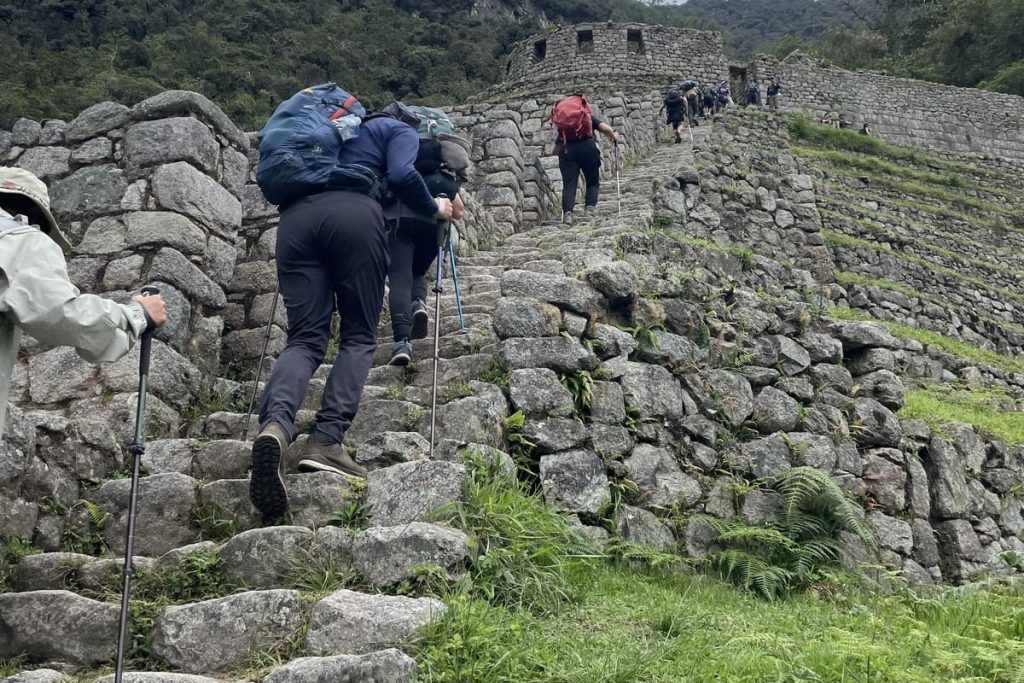
Inca Trail difficulty in one line: the trek is moderately hard, harder than a long day hike and well short of a mountaineering trip. It needs no climbing skills. What makes it hard is the mix of three things: altitude, with Dead Woman’s Pass at 4,215 m on Day 2; thousands of uneven stone steps, up and down; and four long days in a row, two of them seven to ten hours on your feet. Most people who train for eight to twelve weeks and spend two nights in Cusco first finish it, and enjoy it.
This page is the honest version, from the team that runs the trek out of Cusco: what each day asks of your legs and lungs, who struggles and why, how it compares with the Short Inca Trail, Lares and Salkantay, and whether it is worth it for you. For the fitness self-test, see how fit you need to be for the Inca Trail; for the full route, permits and packing, our Inca Trail guide.
- Distance: 42 km (26 miles) over 4 days and 3 nights of camping.
- High point: Dead Woman’s Pass (Warmiwañusqa), 4,215 m (13,828 ft), on Day 2.
- Hardest day: Day 2, about 1,200 m up and 600 m down in 11 km.
- Longest day: Day 3, 16 km and about 1,400 m of descent.
- Time walking: 5 to 10 hours a day on Days 1 to 3, about 2 hours on Day 4.
- Technical skill: none. No ropes, no scrambling, no exposure beyond steep steps with drops beside them.
How hard is the Inca Trail, really?
On a five-point scale, where 1 is a half-day walk and 5 is a high glaciated peak, we put the Classic Inca Trail at a 3. It is harder than its 42 km suggests, because the distance is not the problem. The problem is that most of it is either climbing or descending stone steps, at an altitude where every breath carries less oxygen, on legs that did the same thing the day before.
Three things decide how hard it feels for you: whether you arrived in Cusco early enough to adapt to the altitude, whether you trained on stairs and descents rather than only on the flat, and how well you sleep in a tent at 3,600 m. Fitness matters, but it is the one of the three that people over-rate.
Inca Trail difficulty day by day
The four days are not equally hard. Day 2 holds the big climb; Day 3 holds the longest descent, and many trekkers find it the harder of the two. Distances and times are for the Classic route from Km 82 at a typical group pace, with short breaks but not lunch. The metres up and down are approximate, worked out from the heights of the passes and camps.
| Day | Distance, time | Up / down | Sleep at |
|---|---|---|---|
| 1 | 11 km, 5–6 h | +300 m / little | Wayllabamba, about 3,000 m |
| 2 | 11 km, 7–9 h | +1,200 m / −600 m | Pacaymayo, about 3,600 m |
| 3 | 16 km, 8–10 h | +450 m / −1,400 m | Wiñay Wayna, about 2,650 m |
| 4 | 4 km, about 2 h | +100 m / −300 m | Cusco or Aguas Calientes |
Day 1: Km 82 to Wayllabamba (11 km)
The gentlest day. From the trailhead at Km 82, about 2,700 m, the path follows the Urubamba and then the Cusichaca valley past the terraces of Patallacta, climbing gradually to camp at about 3,000 m. It is warm and often sunny at this height. The mistake we see on Day 1 is walking it too fast because it feels manageable: you pay for that on Day 2.
Day 2: over Dead Woman’s Pass (11 km)
The day the trail is known for. You climb about 1,200 m, first through woodland, then over open grassland where the steps get steeper and the air thinner, to Dead Woman’s Pass at 4,215 m. The last hour is slow for everyone, fit or not. Then you walk down about 600 m of steep, uneven steps to camp at Pacaymayo, about 3,600 m, the highest and coldest night of the trek. For many people that descent, on tired legs, is harder than the climb.
Day 3: two more passes and the long way down (16 km)
The longest day, and the one first-timers underestimate. You climb again to Runkurakay Pass (published heights run from about 3,850 to 3,970 m), pass the sites of Sayacmarca and Phuyupatamarca, then descend roughly 1,000 m of stone staircase through cloud forest to Wiñay Wayna, whose sign reads 2,666 m. Your lungs get a break; your thighs and knees do not. This is the day that trekking poles earn their keep. The Inca sites along the way mean frequent stops, which helps.
Day 4: to the Sun Gate and Machu Picchu (4 km)
Short but early: on our trek the day starts at 4:00 a.m., and you walk the first part by headlamp. The path is mostly gentle, apart from a short, near-vertical flight of steps just before the Sun Gate (about 2,720 m). Then you walk down to Machu Picchu at 2,430 m and spend the rest of the morning on your feet inside the site. Our Inca Trail itinerary, hour by hour has the full timings, camps and meals for each day.
What makes it hard: altitude, steps and four days in a row
Altitude
Cusco, where you start, sits at about 3,400 m. At Dead Woman’s Pass the air pressure is about 59% of sea level (a standard-atmosphere estimate), so each breath holds roughly 40% less oxygen. You spend only a few hours above 4,000 m, which is why serious altitude illness is less common here than on higher treks, but headaches, breathlessness and poor sleep are common in the first days in Cusco and on Day 2.
Fitness does not protect you. The CDC’s guidance on altitude illness is blunt about it: training and physical fitness do not affect your risk. Time at altitude does. That is why we ask everyone to spend at least two nights in Cusco or the Sacred Valley before the trek. Our guide to altitude sickness in Peru covers symptoms, prevention and when to see a doctor.
Stone steps, up and down
Much of the trail is Inca paving and staircase: steps of uneven height, some knee-high, often wet and polished. Nobody has an official count, but there are thousands, most of them on Days 2 and 3. Climbing them leaves you breathless; descending them is what makes your legs sore, because your thigh muscles work while they lengthen to brake each step. Across the four days you descend more than you climb, about 2,300 m down against 2,050 m up.
Long days, back to back
Any one day of the Inca Trail is within reach of a regular hiker. Four in a row, with early starts and nights in a tent, is what wears people down. Days 2 and 3 together mean 15 to 19 hours of walking. Sleep at 3,600 m is often broken, and you start Day 3 already tired. Our sleeping bags are rated to −5°C for a reason: the high camp is cold.
Weather and trail conditions
The dry season runs from May to September and the wettest months from November to March; the trail closes every February for maintenance. Rain can come in any month, and wet granite steps are slippery, so a rainy Day 3 is noticeably harder. Heavy rain can also close the trail outside February: in 2026, Routes 1, 2 and 3 closed in mid-August after flash floods and reopened on 5 September. Our guide to the best time to hike the Inca Trail goes month by month.
Who struggles on the Inca Trail, and why
After many seasons in Cusco, the people who have a hard time are rarely the least athletic in the group. They are usually one of these:
- People who arrive in Cusco the day before. Their bodies have had no time to adapt, so Day 2 hits them at the same time as the altitude does. Two nights first, three if you can.
- Fit people who trained only uphill or on the flat. Runners and cyclists often cruise the climb to Dead Woman’s Pass, then struggle on the descents of Days 2 and 3, which use their legs in a way running never does.
- Anyone with knee or hip problems. The descents load the joints for hours. Poles, strength work and a slow pace help a lot; check with a physiotherapist if you have a known problem.
- People carrying too much. Everything in your daypack goes up 1,200 m on Day 2. A kilo of extras on the flat is a real cost on the pass.
- Poor sleepers. Cold, altitude and a tent can mean little sleep on night 2, and fatigue builds from there.
- People who race Day 1. It feels gentle at 2,700 to 3,000 m, and going hard there leaves less for the pass.
And the people who do well? Beginners who trained on stairs and hills for three months, including many first-time hikers in their fifties and sixties. If you have a heart or lung condition, see your doctor before you book. Our page on Inca Trail safety, injuries and evacuation covers the medical side.
Fitness benchmarks: are you ready?
You need moderate fitness, not an athlete’s. A quick check you can do this week:
- Climb 10 flights of stairs (about 200 steps) without stopping.
- Walk uphill for 45 minutes without a break, carrying a 5 kg daypack.
- Walk 15 km on mixed ground in about four hours, and 10 km again the next day.
- Step down from a knee-high ledge 30 times on each leg without knee pain.
If you manage all four without strain, eight weeks of focused training is enough. If they are hard, give yourself the full twelve. The full eight-point fitness self-test tells you where to start, and our 12-week Inca Trail training plan builds up to 18 to 20 km hikes with 600 to 750 m of climbing, on two days in a row.
How it compares: Short Inca Trail, Lares and Salkantay
Three alternatives end at Machu Picchu too. Each is hard in a different way.
| Classic Inca Trail | Short Inca Trail | Lares | Salkantay | |
|---|---|---|---|---|
| Trekking | 4 days, 42 km | 1 day, 12 km | 3–4 days, about 33 km | 5 days, 74 km |
| High point | 4,215 m | about 2,720 m | about 4,500 m on our route | 4,630 m |
| Nights on the trek | 3 in tents | none (hotel) | 2 in tents on our route | 4 |
| Permit | yes | yes | no | no |
| Hardest part | steps, Day 2 pass, Day 3 descent | 600 m climb on steps | altitude, rougher paths | highest pass, cold camps |
Short Inca Trail (2 days). One day of walking, 12 km in 6 to 7 hours from Km 104 (about 2,150 m) up to Wiñay Wayna and the Sun Gate, then a night in a hotel in Aguas Calientes and Machu Picchu the next morning. The climb is about 600 m on stone steps and the altitude is moderate, so it is the gentlest way to arrive on foot. See the Short Inca Trail 2-day tour.
Lares. No permit, fewer steps and far fewer people, through weaving villages and high lakes. It goes higher than the Inca Trail, with our 7-day trip crossing the Ipsayccasa pass at about 4,500 m, so the altitude is the harder part. Compare them in Lares vs Inca Trail.
Salkantay. The hardest of the four: 74 km over 5 days and a pass at 4,630 m, about 400 m higher than Dead Woman’s Pass, with cold first nights. It has fewer stone steps, so knees fare better, but lungs work harder. Our Salkantay trek guide has the details.
Is the Inca Trail worth it?
For most people who choose it, yes, and the reason is the walk itself rather than the destination. You can reach Machu Picchu by train in a morning. What the trail gives you is four days through the country the Incas built it for: Runkurakay, Sayacmarca, Phuyupatamarca and Wiñay Wayna, which you only see on foot; the change from dry valley to high grassland to cloud forest; and the arrival at the Sun Gate, looking down on Machu Picchu after earning it.
It is worth it if:
- you want the walk and the sites along it, not just Machu Picchu;
- you can train for eight to twelve weeks and arrive in Cusco two nights early;
- three nights of camping with shared toilet tents does not put you off;
- you can book ahead: permits sell out 3 to 6 months in advance, earlier for April to September (check permit availability).
Choose something else if:
- you have knee, heart or lung problems your doctor is unsure about: the Short Inca Trail or a full-day Machu Picchu tour by train gets you there with far less strain;
- your dates are fixed and close, and permits are gone: Lares and Salkantay need no permit;
- you want solitude: permits are capped each day, but every permit holder walks the same path to the same camps, so you share the trail with other groups;
- the money matters more than the walk: the Classic trek is from $749 per person, more than a train day trip.
One honest trade-off: you reach Machu Picchu tired, after a 4:00 a.m. start and three hard days. If seeing the site fresh matters more to you than the walk, spend a second day there or choose the train.
How to make the Inca Trail less hard
- Spend two nights in Cusco or the Sacred Valley first, and take the first day slowly. This does more for Day 2 than any training.
- Train descents, not just climbs: stairs with a pack, slow step-downs, and long weekend hikes on two days in a row.
- Use trekking poles with rubber tips. They take strain off your knees on Days 2 and 3. You can rent them from us.
- Keep your daypack light. On our trek the porters carry the tents, kitchen and food; if you want to carry less yourself, add an extra 5 kg porter load when you book. Our Inca Trail packing list shows what is worth its weight.
- Walk at the guide’s pace. Above 3,500 m our guides hold the group to 1.5 to 2 km an hour, which feels slow and is meant to.
- Say how you feel. Our guides check every trekker twice a day with the Lake Louise altitude score and a pulse oximeter, so tell them about a headache early.
- Eat and drink even without appetite. Altitude dulls hunger, and an empty tank makes the pass much harder.
Our groups average 8 trekkers, with a maximum of 16 and one guide for every six, so a slower walker is never left behind.
About this guide. Written by the Inca Trail Reservations team in Cusco. Our guides average eight years on the trail, most were born in the Cusco region and speak Quechua, and the day-by-day figures above are the ones they plan each trek around. Heights come from published sources and from GPS readings on our own trail photos. Reviewed on 8 October 2026.
Ready to walk it? The Classic Inca Trail 4-day tour is from $749 per person, with a $250 deposit. Questions about your fitness or dates: write to info@incatrailreservations.com.