
Most Machu Picchu itineraries treat the Sacred Valley as a highway to be crossed, not a destination in its own right. That’s a mistake. Between Cusco and Aguas Calientes sits a string of Andean towns and archaeological sites (Pisac, Ollantaytambo, Chinchero, and the twin sites of Moray and Maras) that hold some of the best-preserved Inca engineering in Peru, alongside market culture and textile traditions that predate the Spanish conquest. This guide covers the valley itself: what each town or site actually is, why it’s worth your time, and how to string them together before or after your trek.
The Río Urubamba carved this valley at a lower, warmer elevation than Cusco, which is part of why the Inca prized it for agriculture and why it remains a working farming region today. You’ll find Inca terracing still in use, weekly markets that locals actually shop at, and small towns where colonial architecture sits directly on top of Inca stonework. None of that requires a Machu Picchu ticket. The valley holds up as a rewarding day or two on its own.
Quick answer: The Sacred Valley (Valle Sagrado) runs roughly from Pisac to Ollantaytambo along the Urubamba River, with Chinchero, Moray, and Maras sitting up on the higher plateau above it. Most travelers see it as a one-day loop from Cusco (either Pisac + Chinchero + Moray + Maras, or Pisac + Ollantaytambo) or split it across two days if they’re continuing on to Machu Picchu, since Ollantaytambo is the usual train departure point. For what comes after the valley, see our Machu Picchu guide.
Sacred Valley at a Glance
Geographically, the Sacred Valley splits into two loops. The lower loop follows the Urubamba River northwest from Cusco through Pisac and on toward Ollantaytambo, the direction Machu Picchu-bound trains eventually run. The upper loop sits on a higher plateau to the west, where Chinchero, Moray, and Maras cluster within a short drive of each other. Trying to cover both loops in a single day is possible with an early start, but most guided tours run one loop or the other.
- Pisac: a market town below a hilltop Inca citadel and terraced hillsides.
- Ollantaytambo: a living Inca-era town grid guarded by a massive terraced fortress, and the launch point for Machu Picchu trains.
- Chinchero: a colonial church built directly on Inca foundations, plus weaving cooperatives keeping pre-Hispanic textile techniques alive.
- Moray: concentric circular terraces cut into a natural depression, widely believed to have served as an Inca agricultural testing ground.
- Maras: centuries-old salt evaporation pans fed by a natural mineral spring, still worked by local families.
None of these sites require booking anywhere near as far in advance as Machu Picchu does, though entrance to several of them is bundled into the regional boleto turístico (tourist ticket) rather than sold individually. That’s worth confirming when you book, since combinations and pricing change from season to season.
Weather follows the same dry-season/wet-season split as the rest of the Cusco region: roughly May through September is drier, sunnier, and busier, while the wet season from November through March brings afternoon rain but thinner crowds and greener terracing. Because the valley sits lower than Cusco, daytime temperatures are usually a few degrees warmer, even if mornings still start cold at altitude.
Pisac
Pisac sits at roughly 2,970 m (9,751 ft), about 33 km (20 mi) northeast of Cusco. That puts it close enough for a half-day trip, and low enough that some travelers use it as a gentle first stop for acclimatization before heading higher into the valley.
The town is best known for its market, which fills the central plaza with textiles, ceramics, jewelry, and produce. The Sunday market is the largest and most touristic, but smaller versions run on other days of the week too, drawing more local shoppers than the weekend crowd. Either way, it’s a good place to see Andean textile patterns and handicrafts side by side before deciding what to buy elsewhere in the valley.
Above town, a hilltop archaeological complex spreads across the ridge: agricultural terraces cut into the steep hillside, a ceremonial and residential sector, and watchtowers with sweeping views back down over the valley floor. Unlike Ollantaytambo’s fortress, Pisac’s ruins are spread across a wider area of ridge and hillside rather than concentrated on one steep face, so exploring them involves more walking than climbing. You can reach the complex by a switchbacking road or by hiking up directly from town, and it’s substantial enough to fill a couple of hours on its own.
Pair the market and the ruins together and Pisac makes an easy, satisfying half-day: a good warm-up stop if it’s your first taste of Inca stonework, or a relaxed final valley stop if you’re working your way back toward Cusco.
Ollantaytambo
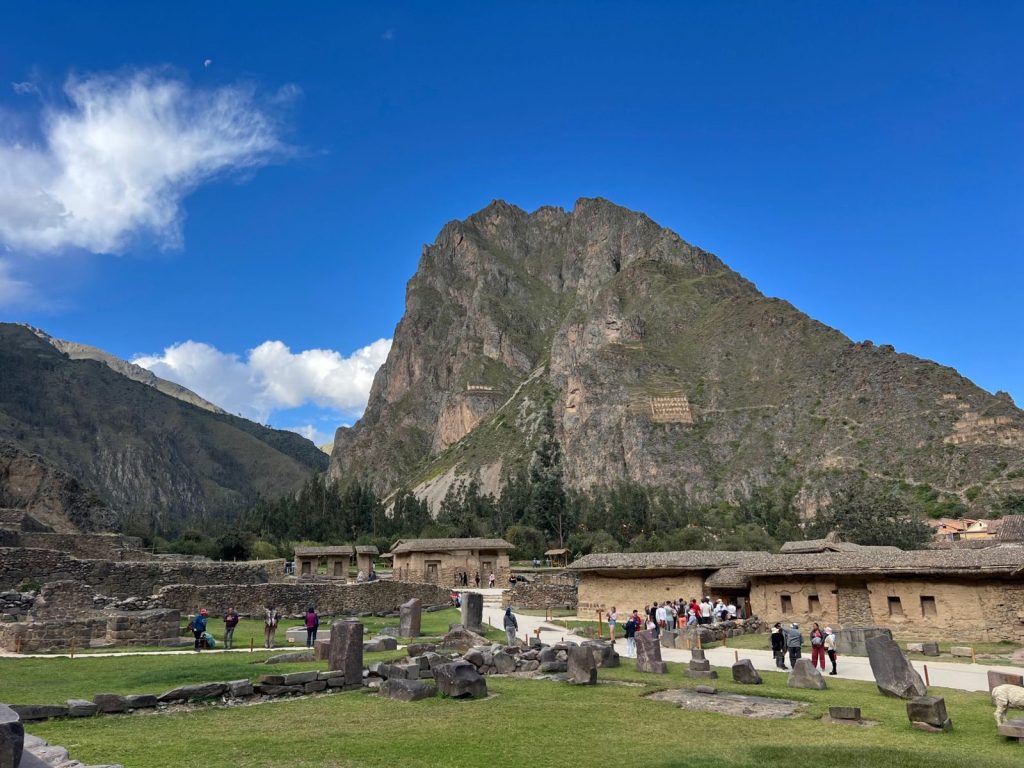
Ollantaytambo sits lower and further down-valley than Pisac, at roughly 2,792 m (9,160 ft), about 60 km (37 mi) from Cusco. What sets it apart from every other stop in the valley is that its old quarter is the original Inca settlement, not a town built near Inca ruins. The narrow stone streets, water channels, and trapezoidal doorways in the town center date back to the Inca period and are still lived in and used today, rather than fenced off as a site.
Above the town, a dramatic run of stone terraces climbs the hillside toward an unfinished temple complex near the summit. The scale of the stonework and the steepness of the climb make it one of the more physically striking sites in the valley. Historically, the site is also notable as one of the rare places the Inca held off a Spanish assault, using the terraces and the surrounding geography to their advantage.
Practically, Ollantaytambo matters for another reason: it’s the main departure point for trains to Machu Picchu, run by both of the region’s rail operators. That means a lot of travelers pass through on their way to the citadel, but treating it purely as a transit stop means missing a town and fortress worth exploring in its own right. Budget time to actually walk the old quarter and climb the terraces rather than rushing straight to the platform.
The terrace climb is steep and sits at altitude, so give yourself more time than the distance suggests, especially if you haven’t spent a few days acclimatizing in Cusco first. Arriving earlier in the day generally means fewer people on the terraces and cooler conditions for the climb, though exact crowd patterns shift with train schedules.
This page covers Ollantaytambo the town and fortress, not Machu Picchu itself or Inca Trail trailhead logistics. For the citadel, see our Machu Picchu guide.
Chinchero
Chinchero sits higher than Cusco itself, at roughly 3,762 m (12,343 ft), about 28 km (17 mi) from the city along the road toward the upper plateau. It’s often the first or last stop on a loop through Chinchero, Moray, and Maras, and its elevation means you’ll feel the altitude here even if you’ve already acclimatized in Cusco.
The town’s colonial church is a textbook example of a pattern repeated across the valley: Spanish builders constructed directly on top of Inca stonework rather than starting from scratch. The lower courses of trapezoidal Inca masonry are still visible at the base of the walls, with the adobe colonial church and its painted interior sitting on top: two eras of construction stacked on the same foundation.
Chinchero is also one of the valley’s centers for traditional weaving. Community-run cooperatives demonstrate the full process from raw wool through to finished textile: washing and carding the fiber, dyeing it with natural plant and mineral pigments, and weaving on a backstrap loom. These techniques predate the Inca and have been passed down largely unchanged. It’s a useful stop if you want to understand what you’re buying before shopping for textiles elsewhere in the valley.
The town also has its own market, plaza, and terracing, with views back across the valley toward the snow-capped peaks beyond. Because Chinchero sits on the plateau rather than down in the river valley, it’s often combined with Moray and Maras rather than with Pisac and Ollantaytambo, and its market runs on a different rhythm than Pisac’s, so check current market days if that’s a priority for your visit.
Moray & Maras
Moray and Maras sit close enough together to visit as a single stop, but they’re unrelated sites with very different purposes.
Moray is a set of concentric circular terraces cut into natural depressions in the plateau, with the largest bowl stepping down through more than a dozen rings. Because each ring sits at a different depth, temperature and growing conditions vary noticeably from the rim to the bottom, which is why the leading theory is that the Inca used Moray as a kind of agricultural laboratory, testing how crops adapted to different microclimates before those varieties were grown at scale elsewhere in the empire. The site’s exact original purpose isn’t definitively settled, but the engineering itself (drainage, terracing, and soil composition varying ring by ring) is well documented.
Maras, a short drive away, is something else entirely: a hillside covered in thousands of small, shallow salt pans (salineras), fed by a naturally saline spring that has flowed from inside the mountain since long before the Inca. Water is channeled into individual pools, where it evaporates and leaves behind salt that local families still harvest by hand, much as their predecessors have for centuries. Seen from above, the pans form an irregular quilt of white and tan across the hillside, which makes Maras one of the more visually distinctive stops in the valley.
Because they’re close together but not directly connected to a town center, Moray and Maras are usually visited as a paired stop on the upper-plateau loop, often combined with Chinchero. Neither site takes long to see on its own. The value is in walking the rim of Moray’s terraces and getting close enough to Maras’s pans to see individual pools and the channels feeding them, rather than viewing either from a distance.
Getting Around
You have a few practical ways to cover the valley. A guided day tour is the most common choice and the simplest way to hit multiple sites in one day with historical context included. Tours typically run either the lower loop (Pisac and Ollantaytambo) or the upper loop (Chinchero, Moray, and Maras). Hiring a private driver gives you the same coverage with more flexibility on timing. Public colectivos (shared minivans) connect the main towns directly from Cusco and between each other, and are the cheapest option if you’re comfortable navigating routes and schedules yourself. Renting a car works too, though mountain roads and unmarked turns make a driver or tour worth the cost for most first-time visitors.
Because the valley splits geographically into a lower river route and an upper plateau route, trying to combine all five towns and sites into a single day means an early start and a lot of driving, with less time actually at each stop. Splitting the valley across two days (lower loop one day, upper loop the next) gives you a more comfortable pace, and lets you use Ollantaytambo as your overnight base and train departure point if you’re heading on to Machu Picchu from there.
If your trip includes Machu Picchu, it’s worth deliberately routing your Sacred Valley days so you end in Ollantaytambo rather than backtracking to Cusco. Spend the night there, then catch a morning train onward, instead of returning uphill only to come back down again the next day. That single routing choice saves real time on a trip that’s already fairly heavy on transport.
Opening hours, individual site tickets, and current boleto turístico pricing all shift from season to season, so confirm the specifics when you book rather than relying on older listings. Once you’ve worked through the valley, our Machu Picchu guide covers what’s next: tickets, circuits, and getting from Aguas Calientes up to the citadel.
About This Guide: This Sacred Valley guide covers Pisac, Ollantaytambo, Chinchero, Moray, and Maras as destinations in their own right, separate from Machu Picchu ticketing and circuits or Inca Trail trailhead logistics, which are covered elsewhere.
Related Articles
- Machu Picchu Travel Guide
- Sacred Valley Excursions from Cusco
- Aguas Calientes Hotels: Where to Stay Near Machu Picchu
- Machu Picchu Ticket Prices 2026: Costs, Types & How to Book
- Machu Picchu Full Day Tour from Cusco
Disclaimer: Elevations and distances given here are approximate and intended as general orientation, not precise trip-planning figures. Archaeological theories about specific sites, including Moray, reflect the leading scholarly interpretation rather than settled fact. Confirm current opening hours, entrance requirements, and pricing directly with us or official sources before you travel.