Ecuador packs remarkable diversity into a country the size of Colorado. Four distinct worlds converge here: the Pacific coast, the volcanic Andes, the Amazon rainforest, and the Galapagos Islands. This is the only place on Earth where you can breakfast watching hummingbirds in cloud forest, lunch beside a steaming volcanic crater, and dine overlooking colonial church spires built on Inca foundations.
Why Ecuador Rewards Adventurous Travelers
Ecuador offers experiences that larger countries spread across thousands of kilometers. Drive three hours from Quito and you’ve crossed from equatorial highlands through cloud forest to subtropical valley. The compact geography means less time traveling between highlights and more time experiencing them.
Unlike Peru’s well-trodden tourist circuit, Ecuador remains under the radar. You’ll find fewer crowds at comparable attractions, lower prices, and communities where tourism hasn’t displaced authentic daily life. The country uses the US dollar, eliminating exchange hassles, and offers excellent value for mid-range and budget travelers alike.
Geographic Superlatives
Stand on Earth’s closest point to the sun at Chimborazo’s summit. Visit the Galapagos, laboratory of evolution. Watch condors soar through the Avenue of the Volcanoes. Ecuador claims superlatives that countries ten times its size cannot match.
Living Indigenous Cultures
Fourteen distinct indigenous nationalities maintain traditions predating the Inca Empire. The Otavalo market showcases Andean textiles unchanged for generations. Amazon communities offer immersive stays in traditional territories where shamanic practices remain central to daily life.
Accessible Adventure
Ecuador’s infrastructure makes adventure accessible without sacrificing authenticity. Paved highways connect major regions. Domestic flights reach the Galapagos and Amazon in under two hours. English is widely spoken in tourist areas while Spanish opens doors to local interaction.
Ecuador’s Four Worlds
The Galapagos Islands: Evolution’s Laboratory
The Galapagos archipelago sits 1,000 kilometers off Ecuador’s coast, a volcanic chain where Charles Darwin formulated his theory of natural selection. These islands remain one of Earth’s most pristine ecosystems, where wildlife shows no fear of humans because they’ve never learned to.
Sea lions lounge on benches beside pedestrians. Marine iguanas sun themselves on black lava rocks. Giant tortoises lumber through highland mists. Blue-footed boobies perform mating dances within arm’s reach. No other destination on the planet offers wildlife encounters like these.
Visitor options: Live-aboard cruises (5-15 days) cover more islands with less transit time. Land-based itineraries use hotels on Santa Cruz, San Cristobal, or Isabela islands with daily boat excursions. Both approaches require certified naturalist guides by law.
The Andes: Avenue of the Volcanoes
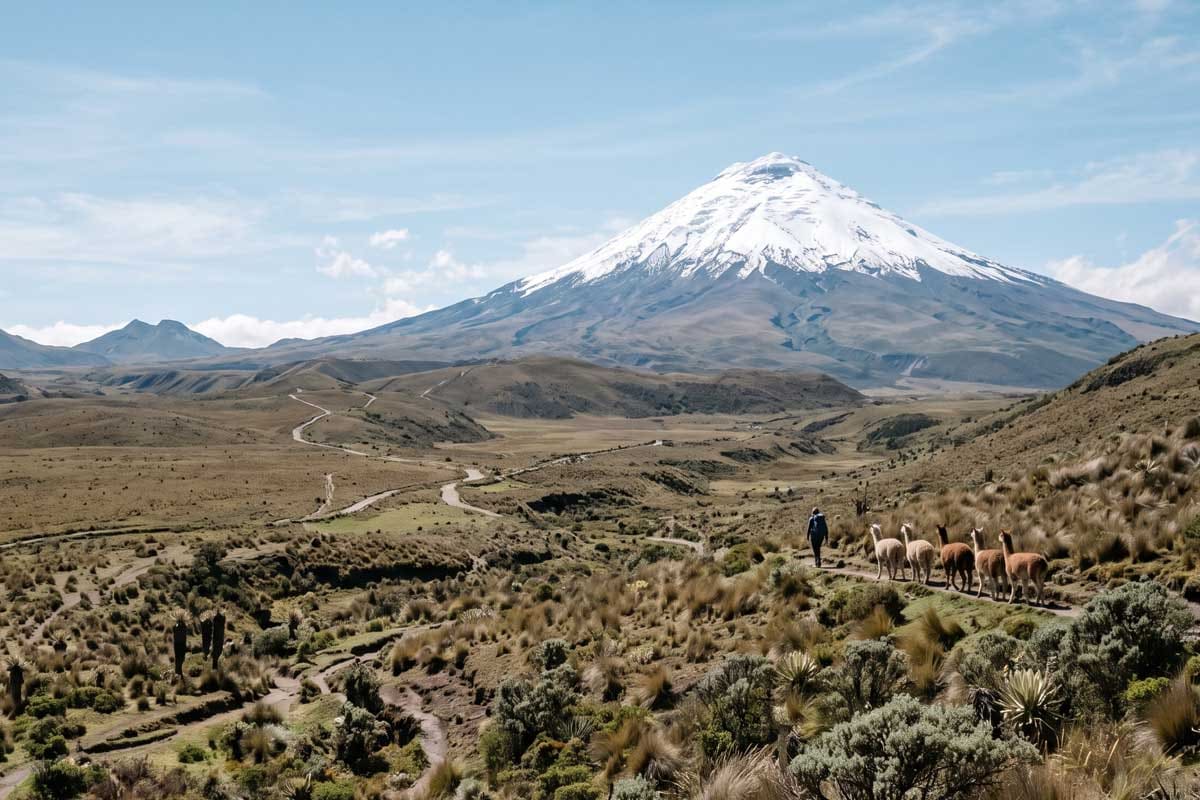
Alexander von Humboldt named this corridor between parallel Andean ranges the \”Avenue of the Volcanoes\” in 1802. Over a dozen peaks exceeding 4,000 meters line the route, including the perfect cone of Cotopaxi (5,897 m) and the massive bulk of Chimborazo (6,263 m), whose summit marks Earth’s closest point to the sun due to the equatorial bulge.
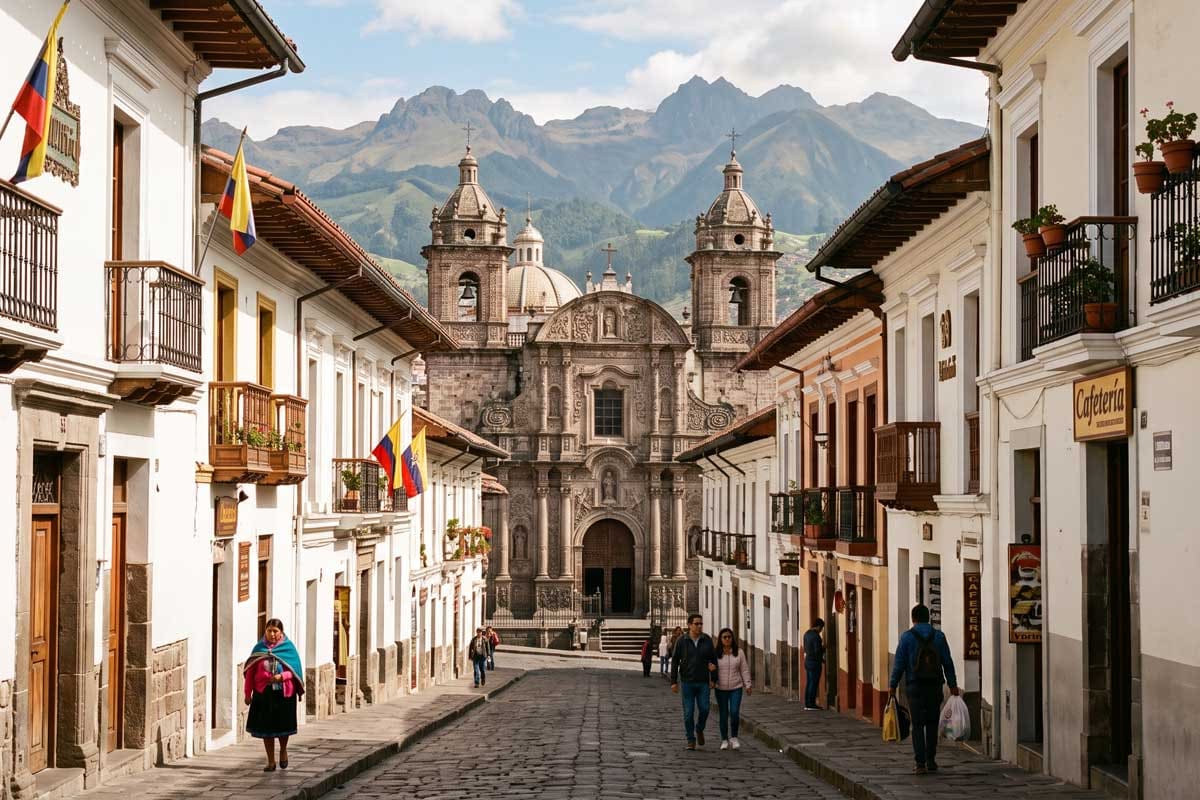
The highlands hold Ecuador’s cultural heart. Quito’s colonial center is a UNESCO World Heritage Site. The Otavalo market ranks among South America’s largest indigenous markets. Hot springs bubble beside volcanic craters. Cloud forests drip with orchids and hummingbirds.
Explore Ecuador Hiking Trails
The Amazon Basin: Yasuni and Beyond
Ecuador’s Amazon region (the \”Oriente\”) occupies the country’s eastern lowlands, where the Andes slope into the world’s largest rainforest. Yasuni National Park holds more tree species per hectare than all of North America combined, along with pink river dolphins, giant otters, harpy eagles, and jaguar.
Eco-lodges accessible by canoe from jungle airstrips offer multi-day immersions in primary rainforest. Activities include canopy walks, night hikes, piranha fishing, and visits to indigenous Huaorani or Secoya communities.
The Pacific Coast: Beaches and Biodiversity
Ecuador’s coast runs 2,237 kilometers from mangrove estuaries near Colombia to desert beaches approaching Peru. Humpback whales breach offshore from June to September. Surfing communities dot the central coast around Montanita. The Machalilla National Park protects dry forest ecosystems and the \”Poor Man’s Galapagos\” at Isla de la Plata.
Most travelers pass through Guayaquil, Ecuador’s largest city and main port, en route to the Galapagos. The city’s riverfront Malecon and Las Penas neighborhood merit a day’s exploration before or after island adventures.
Quito: Gateway to Ecuador Adventures
Ecuador’s capital sits at 2,850 meters in a valley flanked by volcanic peaks. The city’s colonial center was the first UNESCO World Heritage Site declared in 1978, preserving churches, monasteries, and plazas built during Spanish colonial rule over Inca foundations.
Beyond the historic center, Quito sprawls north into modern neighborhoods with international restaurants, craft breweries, and boutique hotels. The teleferico (cable car) climbs to 4,100 meters on Pichincha volcano’s flanks, offering views of the city and surrounding peaks on clear mornings.
Don’t miss: La Compania church’s gold-leafed interior (Baroque excess at its finest), the Mitad del Mundo equator monument (the actual equator line sits 240 meters away), and the Mariscal neighborhood’s evening scene. Allow 2-3 days for Quito exploration and altitude acclimatization before highland adventures.
Ecuador Hiking & Trekking
Ecuador’s volcanic highlands offer trekking and mountaineering across every difficulty level. Our Ecuador trekking guide covers all routes with difficulty ratings, guide requirements, and seasonal conditions. Key highlights:
- Cotopaxi Summit (2 days) – Technical climb on one of Earth’s highest active volcanoes (5,897 m). Trail details
- Chimborazo Summit (2-3 days) – Ecuador’s ultimate mountaineering challenge at 6,263 m. Trail details
- Quilotoa Loop (3-4 days) – Village-to-village trek that ends at a turquoise crater lake. Trail details
- El Altar Circuit (3 days) – Andean circuit past glacial lakes and volcanic amphitheater. Trail details
Getting to Ecuador
Ecuador has two international airports: Mariscal Sucre International (UIO) in Quito and Jose Joaquin de Olmedo International (GYE) in Guayaquil. Both receive flights from Miami, Houston, Atlanta, New York, and Latin American hubs including Bogota, Lima, and Panama City.
Fly into Quito for highland and Amazon adventures; fly into Guayaquil for direct Galapagos connections. Note that Quito’s airport sits at 2,400 meters, so you’ll feel the altitude immediately upon arrival. Galapagos flights ($350-500 roundtrip) depart from both cities on Avianca and LATAM. Book early for peak season (June-September, December-January).
Border crossings connect Ecuador to Peru (Huaquillas on the coast, Macara in the highlands) and Colombia (Tulcan-Ipiales). International buses run these routes, or cross independently and catch domestic transport on either side.
Visa & Entry Requirements
Most nationalities receive 90-day visa-free entry. Passport validity must extend at least six months beyond your arrival date. Galapagos visits require a Transit Control Card ($20, purchased at departure airport) and proof of onward travel. Yellow fever vaccination may be required if arriving from endemic countries.
Currency & Costs
Ecuador adopted the US dollar in 2000, simplifying money matters for North American travelers. ATMs are widely available in cities but scarce in rural areas and small towns. Credit cards work in tourist establishments but cash remains essential for markets, small restaurants, and transportation.
Budget travelers manage on $35-50/day (hostels, local food, buses). Mid-range travel runs $80-150/day (comfortable hotels, restaurants, guided activities). The Galapagos significantly increases costs: budget $200-400/day for land-based itineraries, $300-600/day for cruises (as of 2026).
Language
Spanish is Ecuador’s primary language, with English widely spoken in tourist areas and the Galapagos. Quechua is spoken in highland indigenous communities, and Shuar in Amazon territories. Basic Spanish significantly enhances your experience outside organized tours and tourist-facing businesses.
Safety
Ecuador is generally safe for travelers using standard precautions. Petty theft occurs in tourist areas and crowded markets; keep valuables secure. Use registered taxis (yellow with orange license plates in Quito) or ride-hailing apps. The Galapagos Islands are exceptionally safe. Highland towns and tourist circuits have low crime rates. For trekking-specific safety advice, see our Ecuador trekking guide.
Health & Altitude
Quito sits at 2,850 meters, high enough to cause altitude symptoms in some visitors. Plan light activities for your first day or two: slow walking, light meals, plenty of water, no alcohol. Most people adjust within 24-48 hours. Yellow fever vaccination is recommended for Amazon visits and may be required if arriving from endemic countries. Hepatitis A, Typhoid, and routine vaccinations should be current. Tap water is not recommended; bottled water is inexpensive and widely available. For altitude-specific protocols on high-altitude climbs, see our Ecuador trekking guide.
Best Time to Visit Ecuador
Ecuador’s equatorial position creates stable year-round temperatures, but rainfall patterns vary by region. The Galapagos is excellent any month: warm season (December-May) brings calmer seas, better snorkeling, and nesting wildlife; cool season (June-November) sees more marine life as the Humboldt Current brings nutrients. Andes dry season (June-September) offers the clearest volcano views. The coast is warmest December-May, with whale watching at Machalilla June-September.
You can usually find good weather somewhere in Ecuador regardless of when you visit. For trail-specific seasonal conditions, see our Ecuador trekking guide.
Expert Insight
\”The biggest mistake visitors make is booking Galapagos first and Cotopaxi second. Fly into Quito, spend three days exploring the city and doing the teleferico ride to 4,100 meters. By day four your body has adjusted to altitude, and you’re ready for highland adventures. Save the Galapagos for the end of your trip as a sea-level reward after the mountains.\” Sofia Paredes, ASEGUIM-certified mountain guide, Quito (12 years, 200+ Cotopaxi and Chimborazo expeditions)
Combining Ecuador with Peru
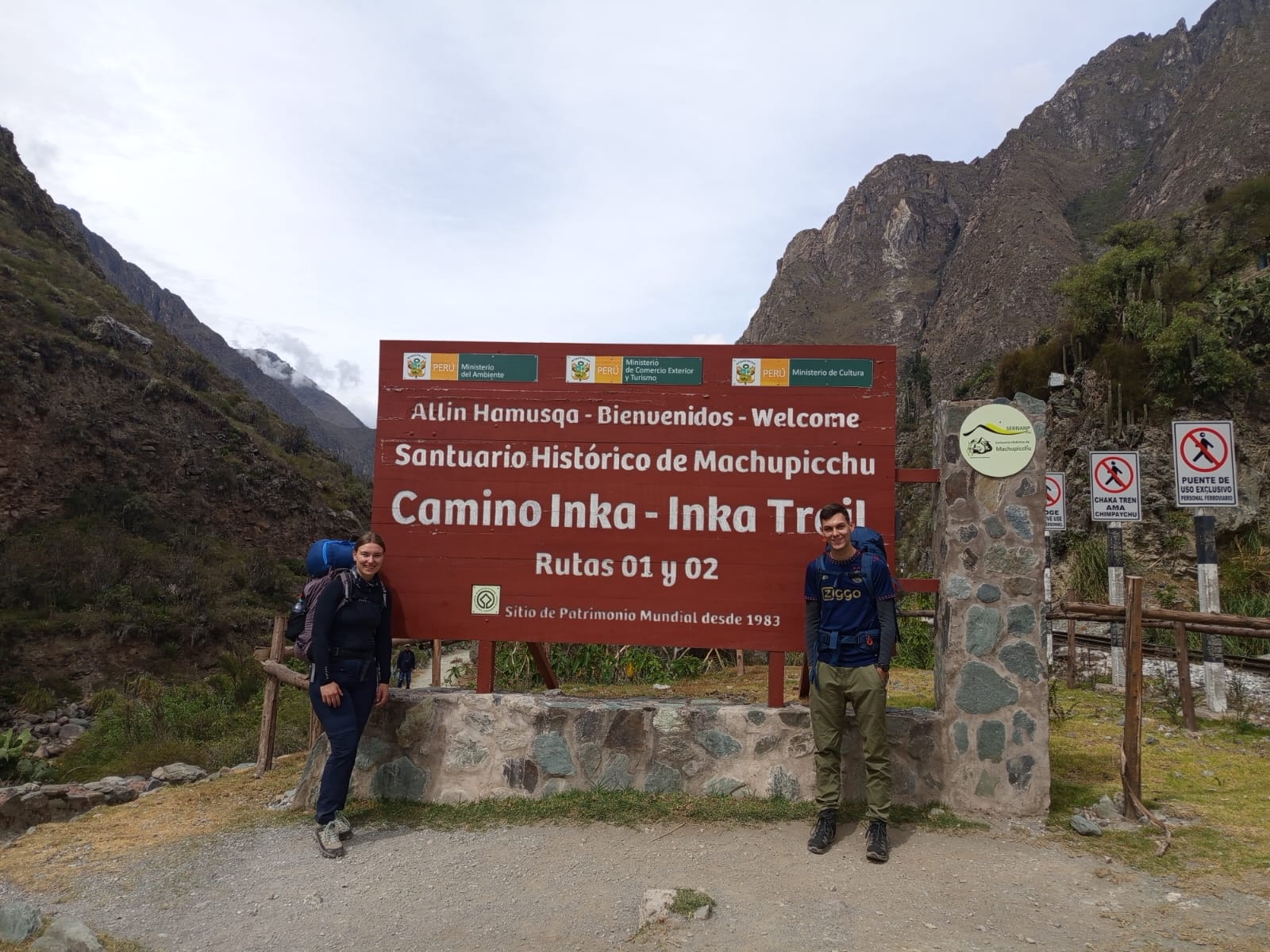
Ecuador and Peru share the Andes, the Amazon, and deep cultural connections. A logical routing flows south: Galapagos and Ecuador’s volcanoes first, then overland or by flight to Lima and Cusco for the Inca Trail and Machu Picchu. This provides natural altitude acclimatization, as Quito at 2,850 meters prepares you for Cusco at 3,400 meters. See our Peru travel guide for planning the full route.
Ecuador Experiences Beyond the Highlights
- Otavalo Saturday Market – South America’s largest indigenous market, where Otavaleno weavers sell textiles using techniques unchanged for centuries
- Quilotoa Crater Lake – Turquoise volcanic lake at 3,914 meters, hikeable as a day trip or part of the 3-day loop
- Mindo Cloud Forest – Hummingbird-rich forests two hours from Quito, with chocolate tours, canopy zip lines, and waterfall hikes
- Banos de Agua Santa – Adventure capital with hot springs, the \”Swing at the End of the World,\” and canyoning, rafting, and biking excursions
- Cuenca – Colonial city rivaling Quito in architectural beauty, gateway to Cajas National Park’s alpine lakes
- Papallacta Hot Springs – Volcanic thermal pools at 3,300 meters, an hour east of Quito on the road to the Amazon
Plan Your Ecuador Adventure
Ecuador rewards travelers who venture beyond the Galapagos. Volcanic highlands, Amazon rainforest, colonial cities, and indigenous cultures create a destination where every day brings something new. Our team brings over two decades of regional expertise to help you plan a Galapagos-focused trip, volcano adventure, or multi-country South American journey connecting Ecuador with Peru.