
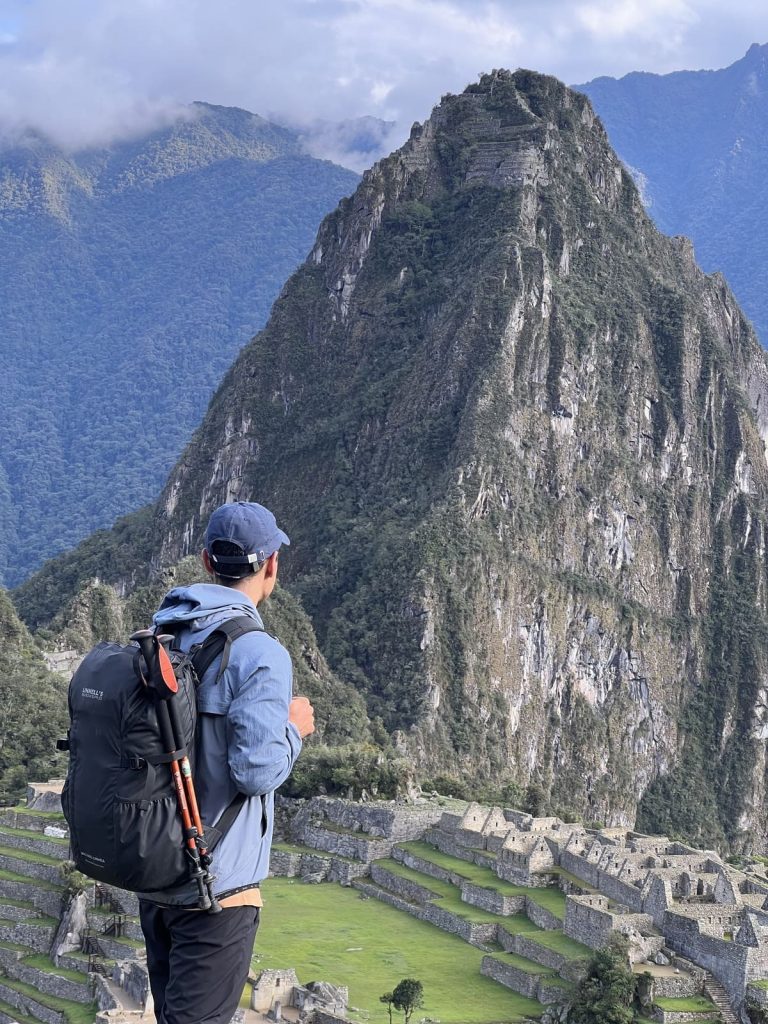
Huayna Picchu is the steep peak that rises behind the ruins in the classic Machu Picchu photo. Machu Picchu Mountain is the bigger, higher peak on the opposite side of the city. You can climb either one, but only with its own timed ticket from Peru’s Ministry of Culture: Huayna Picchu is Route 3-A on Circuit 3, and Machu Picchu Mountain is Route 1-A on Circuit 1. This guide compares the two climbs, and the smaller Huchuy Picchu, with every price, entry slot and limit checked on 8 October 2026 against the Ministry’s tariff, its route maps and its ticket platform.
We book these tickets from Cusco for travelers on our Inca Trail treks and Machu Picchu tours. So the last part of the guide covers the question most guides skip: how a climb fits around an Inca Trail permit.
Quick answer: Huayna Picchu (about 2,690 to 2,720 m) is the shorter, steeper and more exposed climb, on narrow Inca stairs close above the city. Machu Picchu Mountain (about 3,060 to 3,080 m) is longer and higher on a steadier grade, with the wider view across the Urubamba valley to the snow peaks of Salkantay and Pumasillo. Each costs S/200 for a foreign adult in 2026, plus the S/11 SERNANP conservation fee, about US$61 in total, and each ticket also covers part of the citadel. One ticket cannot include both. Huayna Picchu tickets are sold for 07:00 or 10:00 entry; Machu Picchu Mountain for 07:00 or 09:00.
Huayna Picchu vs Machu Picchu Mountain at a Glance
The three climbs side by side. Route codes, distances, effort ratings, time limits and prices are the Ministry’s own; heights come from topographic surveys, which differ by a few tens of metres, so we give the range.
| Huayna Picchu | Machu Picchu Mountain | Huchuy Picchu | |
|---|---|---|---|
| Ticket | Circuit 3, Route 3-A | Circuit 1, Route 1-A | Circuit 3, Route 3-D |
| Also on the ticket | The lower city: Temple of the Sun, House of the Inca, Temple of the Condor | The terraces by the Guardian’s House (the postcard view), not the city streets | The same lower-city walk as 3-A |
| Height of the top | About 2,690 to 2,720 m | About 3,060 to 3,080 m | A low hill beside Huayna Picchu |
| Climb above the city (2,430 m) | About 260 to 290 m | About 630 to 650 m | Short |
| Whole route, there and back | About 2.4 km | About 3.8 km | About 1.7 km |
| Ministry’s effort rating | High | High | Medium |
| Maximum stay | 6 hours | 7 hours | 3 hours 30 minutes |
| Entry hours on sale (8 Oct 2026) | 07:00 and 10:00 | 07:00 and 09:00 | 09:00 and 11:00 |
| Season | All year, except maintenance closures | All year, except maintenance closures | High season only |
| Foreign adult, 2026 | S/200 + S/11 SERNANP | S/200 + S/11 SERNANP | S/152 + S/11 SERNANP |
The distance is the Ministry’s figure for the whole route, city section included. Your ticket names one route, and the paths inside the site run one way, so you cannot switch from Huayna Picchu to the mountain on the day. For what each of the ten routes covers, see our Machu Picchu circuits guide.
What Is Huayna Picchu?
Huayna Picchu, spelled Waynapicchu in the Ministry’s documents, is the sugarloaf peak at the north end of the ridge that holds Machu Picchu. The name comes from the Quechua wayna (young) and pikchu (peak): the young peak, facing Machu Picchu, the old peak. The Urubamba River loops around its base, and the Incas built a stairway up its face, with terraces and small buildings near the top.
On the far side of the mountain, below the city, sits the Great Cavern, a cave lined with fine Inca masonry and niches that is often called the Temple of the Moon. That name is a modern label, not an Inca one. The cave has its own ticket, Route 3-C, which is covered below.
If you have seen one photo of Machu Picchu, Huayna Picchu is the peak in it. The view from its top runs the other way: straight down onto the plazas, terraces and the switchback road climbing up from the river.
The Huayna Picchu Climb
Route 3-A starts on the farming terraces near the entrance and crosses the lower city past the Temple of the Sun, the House of the Inca, the ceremonial fountains and the Three Doorways compound. The mountain trail starts at a control post by the Sacred Rock, at the north end of the city. From there an Inca stairway climbs the face of the peak to the terraces near the top, and you come back the same way, passing the Temple of the Condor on the way out. The Ministry puts the whole route at about 2.4 km there and back and rates it as high physical effort.
How long it takes
Plan on 2 to 3 hours for the mountain section, there and back, with stops for photos and breath. Fit hikers move faster; people who dislike heights take longer on the descent. The ticket allows a maximum of 6 hours inside the site from the moment you pass the main gate, so there is time for the lower city as well.
Difficulty and exposure
The climb is short, but it is a staircase. The Inca steps are narrow and often higher than a modern stair. In places they run along drops of several hundred metres, with only a cable or a rock to hold. Near the top, some sections are steep enough that most people use their hands. The altitude gain is modest, roughly 260 to 290 m above the city, so the problem is not oxygen but nerves and knees, and the descent is where people slow down.
- Skip it if exposure makes you freeze, or if your knees complain on steep downhill stairs. Machu Picchu Mountain or Huchuy Picchu are the better choice.
- Wet season matters. From November to March the stone gets slick, and the Ministry closes climbing routes when the risk is too high. In 2025, heavy rain closed Huayna Picchu from 5 March to 11 April and Machu Picchu Mountain from 8 March to 26 April (RM 000099-2025-MC).
- Maintenance closures happen too. Huayna Picchu was closed for conservation work for the whole of June 2026 (RM 000317-2025-MC). If a route shows no dates at all, check for a closure before assuming it sold out.
Route 3-C: the Great Cavern
Route 3-C, sold only in high season, uses the start of the Huayna Picchu trail from the Sacred Rock control post and then takes the long path around the back of the mountain to the Great Cavern. The Ministry’s route map and description do not include the top of Huayna Picchu. It is about 3 km there and back, rated high effort, allows 7 hours, and costs the same S/200 as Route 3-A. On the late-December dates we checked, it was sold for 08:00 and 09:00 entry.
The Machu Picchu Mountain Climb
Route 1-A belongs to Circuit 1. It starts on the upper and lower terraces by the Guardian’s House, where the postcard photo of the city is taken. Then it leaves the site on the trail to Machu Picchu Mountain, the large peak south of the ruins. The Ministry describes a round trip of about 3.8 km at high physical effort, and says the top gives views of the Salkantay and Pumasillo snow peaks and of the whole landscape around the city.
- Time: plan on 3 to 4 hours there and back, about 1.5 to 2 hours of it on the way up. The ticket allows 7 hours in total.
- The grade: a long, steady Inca staircase through cloud forest, with fewer exposed edges than Huayna Picchu but about twice the height gain, roughly 630 to 650 m above the city. At around 3,000 m you notice the altitude more than on Huayna Picchu.
- The view: the city looks small from up here, with Huayna Picchu behind it and the river far below. If you want the ruins close and dramatic, Huayna Picchu gives you that; if you want the whole setting, the mountain does.
- What you do not see: Circuit 1 stays on the terraces. The temples and plazas of the city are not on this ticket.
Machu Picchu Mountain tends to stay available longer. On 8 October 2026 the official calendar had Machu Picchu Mountain dates open from 28 October, while the first open Huayna Picchu date was 21 November.
Huchuy Picchu: The Shorter Third Option
Huchuy Picchu (“little peak”) is the small hill next to Huayna Picchu, reached on Route 3-D. It is still sold, but only in high season: in 2026 that means 1 January, 2 to 5 April, 19 June to 2 November and 30 and 31 December. The Ministry describes a round trip of about 1.7 km at medium effort, with views over the city and the valley from its top, and allows 3 hours 30 minutes inside.
It costs the same as a standard ticket, S/152 for a foreign adult, and on the official calendar for 31 December 2026 it was sold for 09:00 and 11:00 entry. On 8 October no Huchuy Picchu dates were left for the rest of October, and 31 December was the only date still open before the end of the year. It suits families and anyone short on time who still wants a view from above, without the exposure of Huayna Picchu.
Daily Caps and Entry Slots
Three different limits apply, and most guides mix them up.
- The whole site: Ministerial Resolution 000285-2025-MC caps Machu Picchu at 5,600 visitors a day on 1 January, 2 to 5 April, 19 June to 2 November and 30 and 31 December 2026, and at 4,500 on other days.
- Each climbing route: the Ministry does not publish an online quota per route on its sites. Figures of 200, 350 or 400 climbers a day that circulate online could not be matched to any official page on 8 October 2026, so treat them as estimates.
- In person: 1,000 tickets a day are sold at the culture office in Machupicchu Pueblo (Aguas Calientes), valid for the following day (Ministry of Culture). The live availability page showed 50 of those for Huayna Picchu and 50 for Machu Picchu Mountain for 9 October 2026.
The entry hour printed on the ticket is the hour you pass the main gate. The Ministry’s entry-hours table gives 30 minutes of tolerance at the gate, or 45 minutes from 1 June to 15 October and on 30 and 31 December. The checkpoints for Machu Picchu Mountain, Huayna Picchu and Huchuy Picchu give no tolerance at all, so on a climbing ticket go straight to the trail control post rather than touring first.
| Climb | Entry hours sold | First open date seen on 8 Oct 2026 |
|---|---|---|
| Huayna Picchu (3-A) | 07:00, 10:00 | 21 November 2026 (07:00 only; 10:00 sold out) |
| Machu Picchu Mountain (1-A) | 07:00, 09:00 | 28 October 2026 |
| Great Cavern (3-C) | 08:00, 09:00 | Late December 2026 (high season only) |
| Huchuy Picchu (3-D) | 09:00, 11:00 | 31 December 2026 (high season only) |
The early slot is the one to want. At 07:00 the trail is cooler, the light is low on the city, and a missed bus from Aguas Calientes is the only real risk, so stay in town the night before. Our Aguas Calientes hotels guide covers where.
Huayna Picchu Tickets: 2026 Prices
A climbing ticket is a whole Machu Picchu ticket, not an add-on: S/200 buys entry to the site on your circuit plus the climb. These are the Ministry’s general prices for foreign visitors under its tariff, RM 000451-2024-MC, as amended by RM 000099-2025-MC and RM 000317-2025-MC.
| Foreign visitor | Huayna Picchu (3-A), Mountain (1-A), Great Cavern (3-C) | Huchuy Picchu (3-D) and standard routes |
|---|---|---|
| Adult | S/200 | S/152 |
| Undergraduate student | S/125 | S/77 |
| Child, 3 to 17 | S/118 | S/70 |
| Under 3 | Free | Free |
Since 1 May 2026 the protected-areas service SERNANP adds a conservation fee at purchase: S/11 for foreign visitors aged 18 and over and S/5 for ages 3 to 17 (RJ 000004-2025-SERNANP). A foreign adult therefore pays S/211 for Huayna Picchu or Machu Picchu Mountain, about US$61, and S/163 for Huchuy Picchu, about US$47. A foreign undergraduate pays S/136 (about US$40) and a child S/123 (about US$36) for a climb. Dollar figures use the Central Reserve Bank rate of S/3.437 per dollar on 6 October 2026; the platform charges in soles, so your card’s rate decides the final number.
Peruvians, foreign residents of Peru and citizens of Bolivia, Colombia and Ecuador pay the 2026 promotional rate set by RM 000284-2025-MC: S/112 for a climbing route (S/80 for students and minors) and S/64 for Huchuy Picchu. The student rate is for undergraduates only, and foreign students show the original card of their university or technical institute. Our Machu Picchu ticket prices guide has every route and discount.
Best Time to Climb and What to Bring
May to September is the dry season and gives the best odds of dry stone and a clear view from the top. April and October are shoulder months. From November to March the stairs are wet and slick, and closures for rain are not unusual, as in March and April 2025. The trade-off is crowds: from 19 June to 2 November 2026 the site takes up to 5,600 visitors a day, and climbing tickets sell out furthest ahead in those months.
- The passport on your ticket. It is checked at the gate, and you may be asked for it again inside.
- Shoes with grip. Worn Inca stone is polished smooth, and a trail shoe with a soft sole holds better than a city trainer.
- Water, a rain layer and sun protection. The trails are steep and sunny by mid-morning, and a shower can arrive in any month.
- A small daypack. The site limits bag size and bans a list of items; our circuits guide has the current list.
Which Climb Should You Book?
- You want the city close up, from above: Huayna Picchu. The ticket also covers the lower city with the Temple of the Sun and the Temple of the Condor.
- You dislike exposure or have weak knees: Machu Picchu Mountain. It is longer and higher, but the drops are less sheer.
- You want the biggest view and the postcard terraces on one ticket: Machu Picchu Mountain, since Circuit 1 starts at the Guardian’s House terraces.
- You are short on time, with children, or visiting from June to October: Huchuy Picchu, the shortest climb, sold in high season only.
- You want both: two tickets on two days, one on Circuit 3 and one on Circuit 1. One ticket never covers both climbs.
- Huayna Picchu is sold out: check Machu Picchu Mountain on the same date, then Huchuy Picchu or the Great Cavern in high season, then the 50 in-person Huayna Picchu tickets sold the day before in Aguas Calientes.
Children are not banned. The Ministry’s tariff sells a minors’ rate for Route 3-A, and no minimum age appears in the documents we checked; the ages of 12 or 14 quoted elsewhere are operator advice, not a rule. The real question is whether your child is steady on exposed stairs. If you are unsure, start with Huchuy Picchu.
Adding a Climb to Your Inca Trail Booking
Your Inca Trail permit includes your Machu Picchu entry, but not a climb. Under Ministerial Resolution 000306-2025-MC, hikers who arrive on the Inca Trail enter the city on Route 3-B, from a daily quota that licensed agencies reserve and pay for. Route 3-B covers the lower city and no mountain, so Huayna Picchu or Machu Picchu Mountain means a second ticket, on Route 3-A or 1-A, bought for you by your operator. Here is how we handle it:
- Ask when you book the trek. On our 4-day classic Inca Trail booking form, tick the Huayna Picchu ticket option; for Machu Picchu Mountain or Huchuy Picchu, write to us. The climbing ticket sells out long before the trek does in some months, so it pays to decide early.
- Choose the day. On day 4 you come through the Sun Gate around sunrise and tour the city with your guide, so a 07:00 climb is out. A day-4 climb means the 10:00 Huayna Picchu slot and a later train back to Cusco, and we check that timing against your departure before we buy. The alternative is a night in Aguas Calientes and a 07:00 climb the next morning; the climbing ticket is your entry for that second day.
- Send your passport details exactly. The ticket is issued in your name and passport number, and the name and date cannot be changed later.
- We buy it on the Ministry’s platform in your name, for the date and entry hour we agreed with you.
Day 4 already starts before dawn after three days on the trail, which our Inca Trail itinerary guide walks through hour by hour. After three days on the trail, a climb the next morning, after a shower and a bed in Aguas Calientes, is often more enjoyable than one squeezed into day 4. Write to us at info@incatrailreservations.com with your dates and we will tell you what is still available.
Rules That Catch Climbers Out
- No changes, no refunds. The ticket is valid only for its date and hour. The holder’s name and the date cannot be changed; only a mistyped passport number can be corrected, and a date change is allowed only for force majeure (Tu Boleto terms).
- Bring the passport you booked with. It is checked against the ticket at the gate, and student or child rates need their proof on the day.
- Be at the trail checkpoint on time. The mountain control posts give no tolerance after your hour.
- One ticket, one route. Paths run one way, and walking onto a route your ticket does not cover can get you removed from the site.
- Buy only on the official platform or through a licensed operator. The Ministry sells online at tuboleto.cultura.pe and in person in Machupicchu Pueblo.
For getting there, when to go and the rest of the visit, start with our Machu Picchu travel guide.
Related Articles
- Machu Picchu Travel Guide
- Machu Picchu Circuits: The 3 Circuits & 10 Routes Explained
- Machu Picchu Ticket Prices 2026: Costs, Types & How to Book
- Inca Trail 4 Days: Classic Trek to Machu Picchu
- Aguas Calientes Hotels: Where to Stay Near Machu Picchu
- Machu Picchu Photography Guide: Light, Viewpoints & Rules
About this guide: Checked on 8 October 2026 against the Ministry of Culture’s tariff (TUSNE, RM 000451-2024-MC, amended by RM 000099-2025-MC and RM 000317-2025-MC), the 2026 promotional rates (RM 000284-2025-MC), the Inca Trail entry rule (RM 000306-2025-MC), the route descriptions and sales calendar on tuboleto.cultura.pe, the official circuits and route maps and entry-hours table, and SERNANP’s 2026 fee (RJ 000004-2025-SERNANP, RD 000022-2025-SERNANP). Heights are topographic estimates and vary by survey.
Disclaimer: The Ministry of Culture changes routes, slots, prices and closures by resolution, sometimes at short notice. Check the route and hour printed on your own ticket before you travel.