Chile stretches 4,300 kilometers along South America’s Pacific edge, compressing desert, glacier, volcano, and vineyard into a country narrower than most US states. A single itinerary can cover the driest desert on Earth, the southern hemisphere’s best stargazing, active volcano craters, and the granite towers of Patagonia.
Why Chile Rewards Adventure Travelers
Chile combines geographic extremes with modern infrastructure. Within a single trip, you can photograph flamingos in Atacama salt flats at dawn, taste Carmenere in colonial vineyards at lunch, and watch glaciers calve into turquoise lakes by evening. Excellent domestic flights, well-maintained highways, and a mature tourism industry make these transitions practical.
Unlike destinations where adventure means roughing it, Chile offers luxury lodges alongside wilderness. Torres del Paine has backcountry refugios and eco-domes with hot tubs. Atacama pairs sunrise geyser tours with afternoon spa soaks. Wine country combines vineyard hikes with fine dining. Adventure and comfort coexist here in a way rare for South America.
Geographic Extremes
The Atacama receives less than 15mm of rain annually (some stations have never recorded precipitation). Patagonia’s glaciers hold the world’s third-largest ice reserve. Between them: 90+ active volcanoes, hot springs, and temperate rainforests with thousand-year-old Alerce trees.
Southern Hemisphere’s Best Stargazing
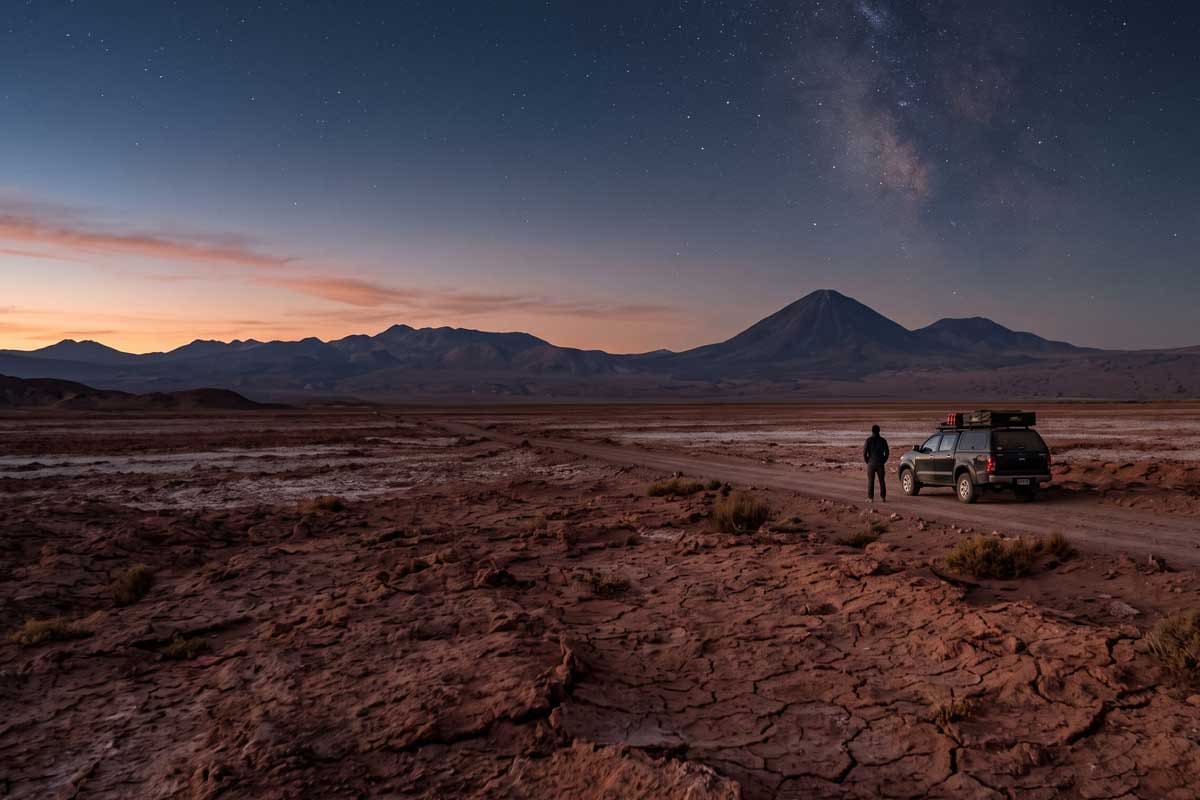
The Atacama’s altitude and aridity create Earth’s clearest night skies. The ALMA observatory (the world’s largest astronomical project) chose this location for good reason. Tourism operations now offer amateur astronomers access to professional-grade telescopes, revealing Saturn’s rings and the Milky Way’s core in detail impossible elsewhere.
Modern Infrastructure
Chile’s stability means reliable ATMs, safe tap water, efficient domestic flights, and English widely spoken in tourism. Adventure here comes with fewer logistical headaches than neighboring countries. Santiago’s metro is clean and efficient; Uber works nationwide.
Regions to Explore
Patagonia
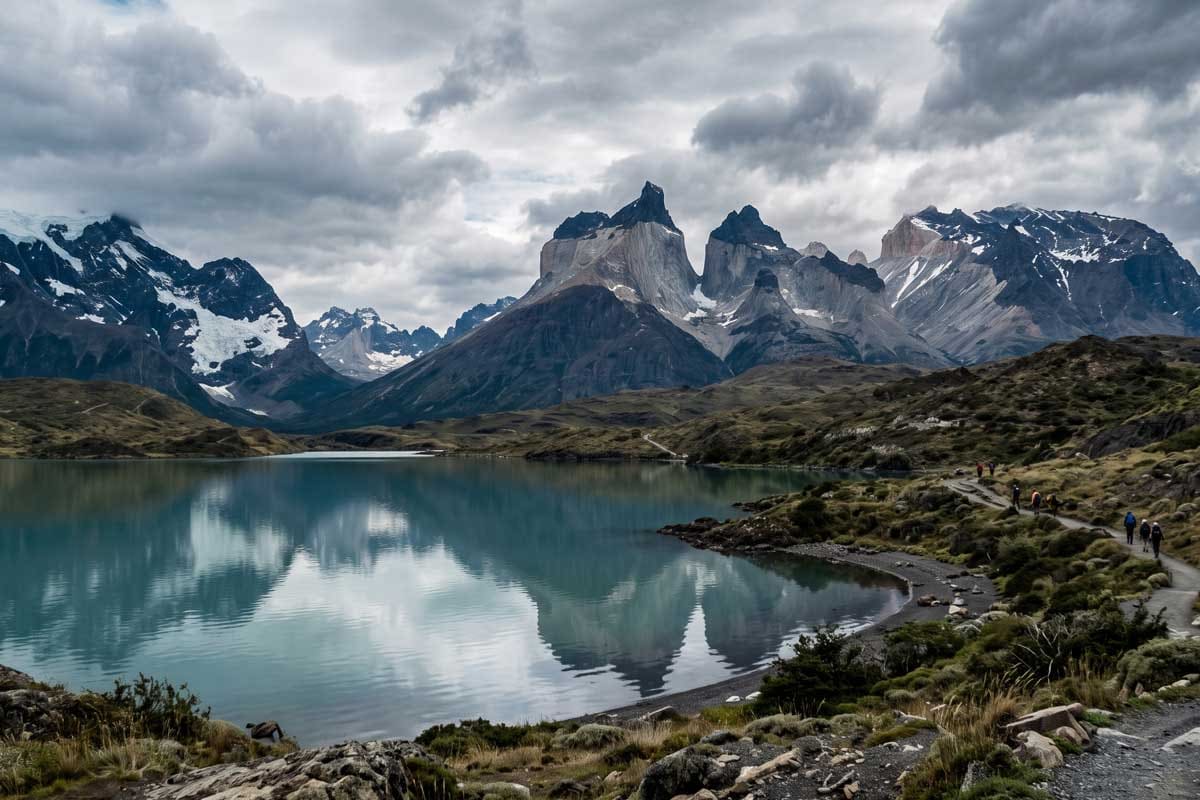
Chilean Patagonia anchors the country’s adventure reputation. Torres del Paine National Park displays granite towers rising 2,500 meters from the steppe, the Grey Glacier grinding toward a milky lake, and guanacos grazing beneath snow-capped peaks. Beyond Torres del Paine, the Carretera Austral runs 1,200 kilometers through fjords, hanging glaciers, and pioneer settlements. Marble Caves glow blue on General Carrera Lake. Queulat National Park hides a hanging glacier visible from the highway.
For trekking routes, campsite reservations, and trail conditions in Patagonia, see our Chile trekking trail guide.
Atacama Desert
San Pedro de Atacama sits at 2,400 meters in the driest desert on Earth, surrounded by salt flats, geysers, and landscapes so extreme that NASA tests Mars rovers here. The town’s adobe streets and craft markets serve as basecamp for dawn geyser visits, sunset Valley of the Moon tours, and flamingo-filled lagoons at altitude. Book astronomy tours during new moon periods for the darkest skies.
The Atacama connects with Bolivia’s Salar de Uyuni via multi-day jeep tours crossing high-altitude desert, colored lagoons, and active geysers. See our Bolivia travel guide for planning the crossing.
Lake District
Chile’s Lake District mirrors Patagonia’s scenery with easier access and milder weather. Snowcapped volcanoes rise above pristine lakes. Towns like Pucon and Puerto Varas blend outdoor adventure with German-Chilean architecture and farm-to-table cuisine. Pucon anchors the region’s activity scene: climb the active Villarrica volcano, raft the Trancura River, soak in volcanic hot springs, or ski the volcano’s slopes in winter. The Cruce Andino lake crossing to Argentina’s Bariloche is a journey as memorable as any destination.
Wine Country
Chile’s central valleys produce acclaimed wines an hour from Santiago. The Maipo Valley (Chile’s oldest wine region) is known for bold Cabernets with Andes views. The Colchagua Valley earned its reputation through Carmenere, a Bordeaux grape that found its best expression in Chilean soil. Casablanca’s coastal fogs produce crisp Sauvignon Blancs. Unlike Napa’s corporate tasting rooms, Chilean wineries often remain family operations where the winemaker pours your glass.
Santiago
Most Chile trips transit through Santiago, but the capital deserves more than an airport connection. The city sits in a valley surrounded by Andes peaks visible from downtown, with skiing 90 minutes away, wine valleys within an hour, and coastal Valparaiso 75 minutes by bus. Bellavista’s restaurants and Pablo Neruda’s La Chascona house, the Lastarria district’s boutiques, and Mercado Central’s legendary seafood all reward a 1-2 day stop.
Easter Island
Rapa Nui sits 3,700 kilometers off Chile’s coast, closer to Tahiti than Santiago. The 900 moai statues remain one of archaeology’s great puzzles. Visiting requires flights from Santiago (5-6 hours) and at least 3-4 days. The island adds significantly to trip costs but offers a destination unlike anywhere else on Earth. February’s Tapati festival showcases Polynesian-Chilean culture at its most vibrant.
Chile’s Hiking Trails
Chile’s trekking ranges from easy Atacama desert walks to expert-level Patagonian circuits. Our guide to Chile hiking trails covers all major routes with difficulty ratings, campsite booking info, seasonal conditions, and gear requirements. Key highlights:
- W Trek, Torres del Paine (4-5 days) – Chile’s most popular multi-day trek through granite towers and glaciers. Trail details
- O Circuit, Torres del Paine (7-9 days) – The full circuit adding the remote northern section. Trail details
- Villarrica Volcano Summit (1 day) – Climb an active volcano to peer into its lava-lit crater. Trail details
- Dientes de Navarino Circuit (4-5 days) – The world’s southernmost trekking circuit. Trail details
- Valle de la Luna, Atacama (half day) – Desert walk through lunar landscapes at sunset. Trail details
Getting to Chile
Santiago’s Arturo Merino Benitez International Airport (SCL) receives most international arrivals, with direct flights from Miami, Atlanta, Dallas, Houston, New York, Los Angeles, Toronto, Madrid, Paris, London, Sydney, and Auckland. LATAM Airlines dominates as Chile’s flag carrier; American, Delta, United, Iberia, Air France, British Airways, and Qantas also serve Santiago.
Domestic flights connect Santiago to Punta Arenas (PUQ, 3.5 hours) for Patagonia, Calama (CJC, 2 hours) for Atacama, and Puerto Montt (PMC, 1.5 hours) for the Lake District. Book Patagonia flights early for December-February. Long-distance buses connect cities along the Pan-American Highway; Turbus and Pullman Bus are the most reliable operators.
Overland crossings connect to Argentina (El Calafate to Puerto Natales for Patagonia, Mendoza to Santiago via Los Libertadores pass, Bariloche to Puerto Varas via Cruce Andino), Bolivia (Uyuni to Atacama), and Peru (Tacna to Arica).
Visa & Entry Requirements
Citizens of 90+ countries (USA, Canada, EU, UK, Australia, and most South American nations) receive visa-free entry for 90 days. You receive a Tourist Card (Tarjeta de Turismo) on arrival; keep it safe, as you must return it on departure. Extensions cost $100 at immigration offices. Passport must be valid for 6 months. Proof of $46 USD daily funds may be requested but is rarely enforced.
Currency & Costs
Chile uses the Chilean Peso (CLP). The country ranks as South America’s most expensive destination; costs approach European levels in Patagonia and Santiago. Budget travelers manage on $70-100/day with hostels and careful choices. Mid-range runs $150-250/day. Patagonia lodges and wine country hotels push luxury budgets past $400/day.
ATMs (“Redbanc”) are ubiquitous in cities and reliable. Credit cards work widely, though carry cash for markets, small restaurants, and rural areas. US dollars are not commonly accepted; exchange before arrival or use ATMs. Patagonia and Easter Island are significantly more expensive than central Chile.
Language
Spanish is Chile’s official language. Chilean Spanish is fast with unique slang (“po” appears after everything, “cachai” means “you know?”). English is widely spoken in tourism contexts (guides, hotels, upscale restaurants) but less common in local businesses. Basic Spanish helps significantly for independent travel but full fluency is not necessary in tourist areas.
Safety
Chile ranks as South America’s safest country for travelers. Violent crime targeting tourists is rare. Petty theft occurs in crowded areas; standard precautions apply. Santiago’s metro is safe and efficient; Uber works throughout the city. Patagonia’s wilderness poses weather and navigation risks rather than security concerns. Emergency number: 133 (Carabineros police).
Best Time to Visit Chile
Chile’s 4,300 km length means climate varies by region. November and March offer the best overlap: Patagonia’s shoulder season (fewer crowds, lower prices) coincides with pleasant conditions elsewhere. Atacama is excellent year-round, with cooler months (April-November) best for stargazing. Wine country peaks during the March-May harvest. Santiago is most pleasant in spring and fall. For trail-specific seasonal conditions and campsite availability, see our Chile trekking guide.
Health
Chile poses minimal health risks. Tap water is safe in cities. No mandatory vaccinations are required. Altitude concerns apply only in northern Chile around Atacama (2,400 m) and the Altiplano (4,000+ m); Patagonia sits at only 100-1,200 m. UV radiation is strong across all latitudes due to the ozone hole; high-SPF sunscreen is essential. For trekking-specific health advice (Patagonian weather exposure, gear for hypothermia prevention), see our Chile trekking guide.
Expert Insight
“People plan their Torres del Paine trek around the weather forecast, but Patagonian forecasts are unreliable beyond 24 hours. Instead, plan around the wind. December and January have the strongest sustained winds (80-100 km/h gusts on exposed ridges). Late February and March see calmer conditions, warmer temperatures, and autumn colors starting in the lenga forests. The park is emptier, the light is softer, and you can actually stand upright on the passes.” Diego Alvarado, CONAF-certified Patagonia guide, Torres del Paine (12 seasons, 300+ W Trek completions)
Combining Chile with Other Countries
Chile pairs naturally with Argentina for Patagonia (El Calafate’s Perito Moreno Glacier plus Torres del Paine, connected by bus). The Uyuni-to-Atacama route creates one of South America’s most spectacular overland crossings via Bolivia. A Peru-Bolivia-Chile circuit covering Cusco, Uyuni, and Patagonia takes 4-6 weeks. See our Peru travel guide and Bolivia travel guide for planning multi-country routes.
Plan Your Chile Trip
Chile rewards travelers who embrace its geographic ambition. A week covers one region well; two weeks allow meaningful combinations; three weeks enable the full north-to-south experience. The country’s infrastructure makes independent travel straightforward, while guided options add expertise for glacier trekking and volcano climbs.