
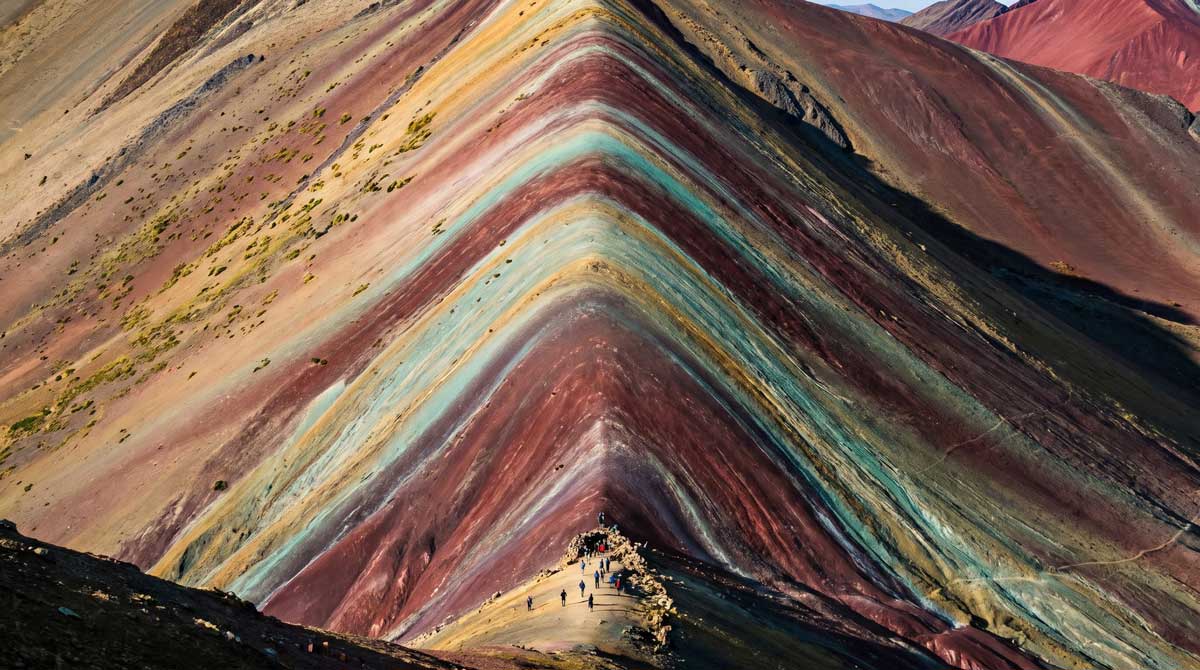
Rainbow Mountain, known locally as Vinicunca or Montaña de Siete Colores (Mountain of Seven Colors), stands at 5,200 meters above sea level in Peru’s Vilcanota mountain range. This geological wonder features natural mineral deposits creating vivid stripes of red, turquoise, yellow, and gold across the mountainside.
Trail Overview
The trek to Rainbow Mountain covers approximately 14 kilometers round trip from the Quesiuno trailhead near Cusipata. Starting at 4,600 meters elevation, you ascend through alpine terrain to reach the summit at 5,200 meters. Most trekkers complete the journey in 3 to 4 hours ascending and 2 to 3 hours descending.
The route follows a well-defined path through high-altitude grasslands and rocky terrain. The final approach to the summit involves a sustained climb on sandy, switchback trails. Clear weather reveals stunning views of the Ausangate glacier and surrounding peaks of the Cordillera Vilcanota.
What to Expect
The trek begins with a 3-hour drive from Cusco to the Cusipata region. From the trailhead at Quesiuno, you start hiking at 4,600 meters altitude. The path gradually ascends through open grasslands where you may see llamas and alpacas grazing.
The trail becomes steeper in the final kilometer, with loose sand and switchbacks testing your endurance at extreme altitude. Upon reaching the viewpoint, you stand face-to-face with the rainbow-striped mountain, its colors most vivid in dry season sunlight. The mineral formations create distinct bands of red iron oxide, yellow sulfur, and green copper compounds.
Many tours include an optional extension to Red Valley (Valle Rojo), adding 1-2 hours to explore rust-colored rock formations in a dramatic canyon setting.
Altitude Challenge
The primary difficulty of Rainbow Mountain is altitude, not technical terrain. At 5,200 meters, the air contains 50% less oxygen than sea level. Spend at least 2-3 days acclimatizing in Cusco (3,400m) before attempting this trek. Common symptoms include shortness of breath, headache, and fatigue.
Reputable tour operators provide oxygen tanks, and a medical station operates at the trailhead. Walk slowly, maintain steady breathing, and stay hydrated. If you experience severe symptoms, descend immediately.
Best Time to Visit
The dry season from May to September offers optimal conditions. Clear skies, minimal rain, and temperatures around 15°C during the day make for comfortable trekking. The summit can drop below 0°C with strong winds.
January and February bring heavy rain, obscuring views and creating muddy, slippery trails. April and October serve as transition months with variable weather. Winter months (June-August) provide the clearest skies but coldest temperatures.
Essential Gear
Layer your clothing for extreme temperature fluctuations. Start with thermal base layers, add insulating mid-layers, and top with a waterproof shell jacket. Bring a warm down jacket for the summit, where wind chill intensifies the cold.
Waterproof hiking boots with ankle support are essential. Trekking poles reduce knee strain on steep descents. Pack high SPF sunscreen, UV-blocking sunglasses, and a wide-brimmed hat as high-altitude sun exposure is intense. Carry 2 liters of water and high-energy snacks.
Getting There
Most visitors join organized day tours from Cusco, departing around 3:00-4:00 AM for the 3-hour drive to Cusipata. Tours include transportation, breakfast, lunch, guide services, and entrance fees. Prices range from 35-100 USD depending on group size and included services.
Independent travelers can take a colectivo or bus from Cusco to Cusipata (2-3 hours, 15-20 soles), then hire local transport to the Quesiuno trailhead (1 hour, 30-50 soles). You must register online at vinicuncacusipata.com before hiking the Cusipata route.
The entrance fee is 25 soles (approximately 7 USD). The optional Red Valley requires an additional 30 soles, paid at the valley entrance.