
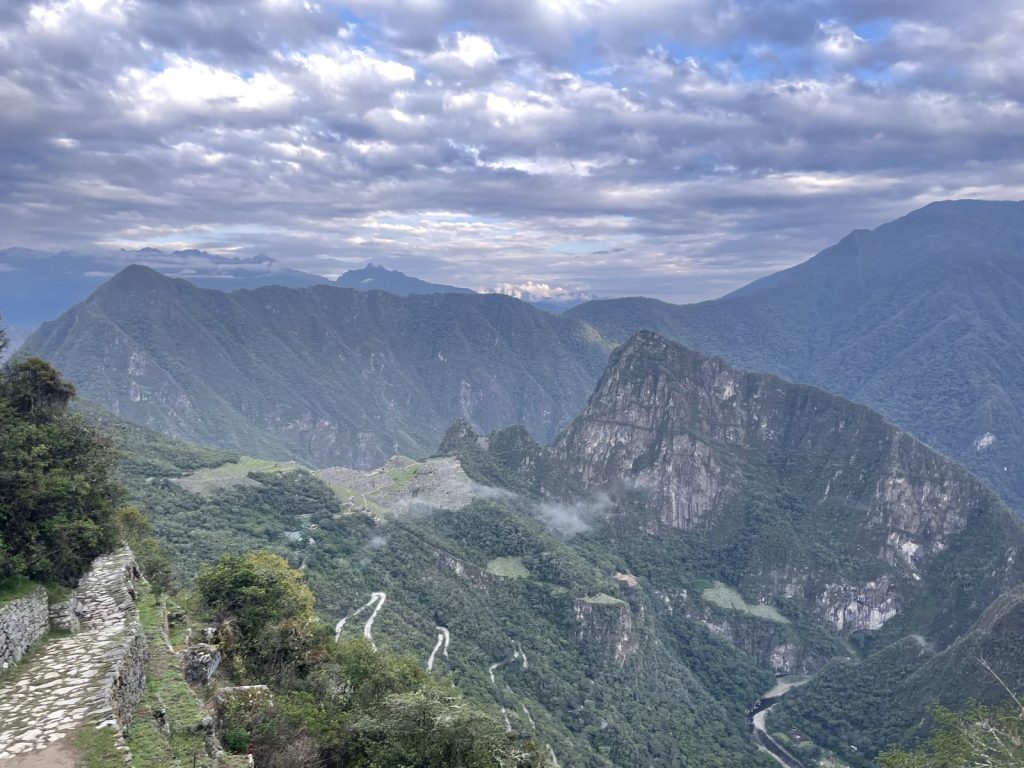
Short answer: in the Lares Trek vs Inca Trail choice, pick the Inca Trail if you want Inca ruins every day and to walk into Machu Picchu through the Sun Gate, and you can book a permit months ahead. Pick the Lares Trek if you want Quechua weaving villages, no permit, and dates you can still get next month. Lares crosses a higher pass (about 4,450 m against 4,215 m) and sleeps higher, but it has far fewer stone steps. It reaches Machu Picchu by train from Ollantaytambo, not on foot.
We run both from our office in Cusco, along with the 2-day Short Inca Trail, so the numbers below come from our own itineraries and price sheets. Where a figure depends on a government rule, we link the source.
| Classic Inca Trail | Lares Trek | |
|---|---|---|
| Days on foot | 4 (Km 82 to Machu Picchu) | 3 (Lares to Ollantaytambo) |
| Distance | About 43 km (26.7 mi) | About 32 to 33 km (20 mi) |
| Highest point | Dead Woman’s Pass, 4,215 m (13,828 ft) | Ipsaycocha Pass, about 4,450 m (14,600 ft) |
| Highest camp | Pacaymayo, about 3,600 m | Huacahuasi, about 3,800 m |
| Permit | Yes, government permit, sold only through licensed operators | None |
| Daily cap | 500 people incl. guides, porters and cooks | No cap |
| What you see most | Inca sites: Llactapata, Runkurakay, Sayacmarca, Phuyupatamarca, Wiñay Wayna | Villages, herders, weaving, glacial lakes, Lares hot springs |
| Arrival at Machu Picchu | On foot through the Sun Gate (Inti Punku) | Train to Aguas Calientes, bus up the next morning |
| Open in February | No, closed for maintenance | Yes |
| Our price from | $749 per person | $999 per person (7-day package with hotels) |
The routes, day by day
Both treks start in the Sacred Valley north of Cusco and finish at Machu Picchu, but they cover different ground. The Inca Trail follows the Urubamba River from Km 82, climbs over two passes and drops into cloud forest. Lares starts on the other side of the Urubamba range, at the hot springs village of Lares, and crosses it toward Ollantaytambo.
Classic Inca Trail, 4 days (our itinerary)
| Day | Route | Distance and time | Where you sleep |
|---|---|---|---|
| 1 | Km 82 (Piscacucho) to Wayllabamba, past Llactapata | 11 km, about 5 hours | Wayllabamba camp, about 3,000 m |
| 2 | Over Dead Woman’s Pass (Warmiwañusqa), 4,215 m | 11 km, 6 to 7 hours | Pacaymayo camp, about 3,600 m |
| 3 | Runkurakay Pass (about 3,950 m), Sayacmarca, Phuyupatamarca | 16 km, 7 to 8 hours | Wiñay Wayna camp, about 2,650 m |
| 4 | Sun Gate (2,720 m) at first light, down to Machu Picchu | 4 to 5 km, 2 to 3 hours | Aguas Calientes or Cusco (not included) |
Day 2 gains about 1,200 m in the morning. Day 3 is the long one: it loses roughly 1,300 m over the day, most of it on stone stairs down from Phuyupatamarca to Wiñay Wayna, which is where most knees complain. Full detail in our Inca Trail itinerary, hour by hour and the Classic Inca Trail route data.
Lares Trek, 3 trekking days (our 7-day itinerary)
| Day | Route | Distance and time | Where you sleep |
|---|---|---|---|
| Trek 1 | Drive from Cusco over a 4,300 m road pass, soak at Lares hot springs, walk up the Trapiche valley | 8 km, about 4 hours | Huacahuasi camp, about 3,800 m |
| Trek 2 | Ipsaycocha Pass (about 4,450 m), past Ipsaycocha lake (about 4,200 m) | 14 km, about 7 hours | Patacancha camp, about 3,700 m |
| Trek 3 | Down the Patacancha valley via Pumamarca ruins to Ollantaytambo (2,792 m), train to Aguas Calientes | 10 km, about 4 hours | Hotel in Aguas Calientes, 2,040 m |
Around this core our 7-day Lares Valley Trek package adds two nights in Cusco before the trek, the Machu Picchu visit on day 6 and a final night in Cusco. Route data for the area is on our Lares Trail page. Note that it profiles the higher Condor Pass variant, which explains its bigger altitude figure (see the next section).
Altitude: why Lares figures range from 4,400 m to 4,800 m
Look up the Lares Trek and you will find maximum altitudes anywhere from 4,400 m to almost 4,800 m. That is not sloppy research. “Lares” is a family of routes across the same valleys, and they cross different passes:
- Ipsaycocha Pass, about 4,450 m (14,600 ft). The standard Lares to Huacahuasi to Patacancha route, the one we run. Published figures for this pass range from 4,400 to 4,500 m.
- Condor Pass, about 4,750 m (15,600 ft). A longer variant via the Canchacancha side, run by some operators; published figures run 4,750 to 4,780 m. This is where the “up to 4,800 m” claims come from.
- Dead Woman’s Pass, 4,215 m (13,828 ft). The high point of the Classic Inca Trail, fixed by the route.
On the standard route, Lares tops out about 235 m higher than the Inca Trail. The bigger difference is where you sleep. Both Lares camps sit at roughly 3,700 to 3,800 m. Inca Trail camps step down from about 3,600 m on night two to about 2,650 m at Wiñay Wayna on night three. A lower night lets your body recover; on Lares there is no lower night until the walking is over.
Important: neither trek should start the day you land in Cusco (3,400 m). We ask for at least two nights in Cusco first. Our Lares package builds those two nights in; on the Classic Inca Trail you arrange them yourself. More in our altitude sickness guide for Peru.
Which is harder?
They are hard in different ways, and the answer depends on which kind of hard you handle better.
- The Inca Trail is harder on legs and knees. About 43 km over four days, most of it on uneven Inca stone steps, with a long climb on day 2 and a long stair descent on day 3. Days run 5 to 8 hours.
- Lares is harder on lungs. About 10 km less walking and mostly dirt paths with few steps, but a higher pass, higher camps and colder nights. The pass day is about 14 km and 7 hours.
- Daily load is lighter on Lares. Our Lares horses carry the camp plus up to 8 kg of your own gear. On our Inca Trail departures porters carry the camp and you carry your daypack; a personal porter for 5 kg of your gear is an $85 add-on on our Classic tour.
If you acclimatize well but have sensitive knees, Lares is usually the kinder trek. If altitude has bothered you before, the Inca Trail’s lower nights help. For a deeper look at the Inca Trail alone, see how hard the Inca Trail is and our 12-week Inca Trail training plan, which works for Lares too.
Permits, crowds and booking ahead
This is where the two treks differ most, and for many travelers it decides the question.
Inca Trail: every hiker, guide, porter and cook needs a permit, sold only through licensed operators. Peru’s Ministry of Culture caps the classic routes at 500 users a day, and the short Km 104 route at 250, under Resolución Ministerial 000294-2025-MC. Roughly 200 of the 500 places on the classic route go to trekkers; the rest are staff. For April to September departures we suggest booking 3 to 6 months ahead. Check open dates on our Inca Trail permit availability page.
Lares: no permit, no daily cap and no checkpoint. We can usually run a departure on short notice, though hotels and trains in Aguas Calientes still fill in June to August. Machu Picchu itself still has a daily visitor limit (5,600 a day in high season, per Andina), so the entry ticket is the part to book early either way.
On crowds: the Inca Trail shares its campsites and the Sun Gate with every other group on that day’s permits. On Lares, most of the people you pass between Huacahuasi and Patacancha are families tending llamas and alpacas, not other trekkers.
Ruins or villages: what you actually see
On the Inca Trail the trek is the archaeology. You walk original Inca paving and stairs from one site to the next: the terraces at Llactapata, the round tower of Runkurakay, Sayacmarca on its rock spur, the ceremonial baths of Phuyupatamarca and the terraces of Wiñay Wayna. See our guide to the Inca Trail archaeological sites.
On the Lares Trek the trek is the people. Huacahuasi and Patacancha are farming and herding communities where women weave on backstrap looms with natural dyes, and you can buy directly from them. The only ruins are Pumamarca on the last morning, plus Ollantaytambo before the train. About 80% of our guides are native Quechua speakers, which matters more on Lares, where conversation with the families is the point.
Pro tip: on Lares, ask before photographing anyone, and carry small soles in cash if you want to buy textiles from the weavers.
How each one reaches Machu Picchu
Inca Trail: on day 4 you leave Wiñay Wayna before dawn, wait at the checkpoint, and walk to the Sun Gate (Inti Punku, 2,720 m) for your first view down onto Machu Picchu. Then you walk down into the site for a 2-hour guided tour. Inca Trail hikers enter on a Machu Picchu quota set aside for them (Route 3-B, per Andina, Peru’s state news agency). Our Classic tour includes that entry.
Lares: you finish walking in Ollantaytambo, take the train down the Urubamba canyon to Aguas Calientes, sleep in a hotel, and ride the first buses up the next morning. You arrive rested and showered, but you arrive like every other visitor. If the Sun Gate walk-in is the reason you are going, Lares will not give it to you on its own (see the combination option below).
Cost: what each price includes
Comparing headline prices is misleading because the packages include different things. Here are our three, side by side.
| Classic Inca Trail, 4 days | Short Inca Trail, 2 days | Lares Trek, 7 days | |
|---|---|---|---|
| Price from, per person (group) | $749 | $595 | $999 |
| Inca Trail permit | Included | Included | Not needed |
| Machu Picchu ticket and guided tour | Included | Included | Included |
| Hotels | None (3 nights camping) | 1 night, Aguas Calientes | 3 nights Cusco, 1 night Aguas Calientes, 2 nights camping |
| Train back toward Cusco | Add-on, from $70 (Expedition train plus bus) | Included | Included |
| Who carries the gear | Porters carry the camp; personal porter $85 per 5 kg | You (daypack only, hotel night) | Horses carry the camp and 8 kg of your gear |
| Deposit | $250 | $250 | See tour page |
Students with a valid university ID pay $699 on the Classic Inca Trail; the conditions are on the Classic Inca Trail tour page. Lares prices rise with the hotel tier you pick in Cusco and Aguas Calientes. For market-wide ranges across operators, see our Inca Trail cost breakdown.
Per trekking day, Lares is not the budget option it is often sold as. Its price covers four hotel nights and both trains, which you would pay for separately around a Classic Inca Trail booking.
Best time for each
Both are best in the dry season, May to September, with April and October as shoulder months. November to March brings afternoon rain on both, and mud on the Lares dirt paths. The deciding month is February: the Inca Trail, including the 2-day route, is closed for maintenance every February (confirmed for 2026 by Andina), while Lares runs year-round. If your only free dates are in February, Lares is the trek of the two you can walk. Month by month detail is in our best-time guide.
Who should choose which
Choose the Inca Trail if
- You want to walk into Machu Picchu through the Sun Gate, on the road the Incas built for it.
- Archaeology is the draw. You walk past five Inca sites on the way, from Llactapata to Wiñay Wayna.
- You can commit 3 to 6 months ahead and travel outside February.
- Altitude has bothered you before. The lower nights on days 3 and 4 help.
Choose the Lares Trek if
- Permits are sold out for your dates, or you are booking within a few weeks.
- You want time with Andean families, weaving and herding, more than ruins.
- Your knees dislike stairs and you handle altitude well.
- You prefer a hotel bed before Machu Picchu and a package that includes Cusco nights and trains.
- You are travelling in February.
Considering the Salkantay route instead? It needs no permit either and climbs to 4,650 m; see our Salkantay Trek guide. For every option side by side, see Peru trekking: the main routes compared.
Can you combine Lares with the Inca Trail?
Yes. Some operators finish a Lares trek with the one-day Km 104 section of the Inca Trail, so you still walk in through the Sun Gate. That section needs its own Inca Trail permit from the 250-a-day quota. It is not one of our listed tours; if you want it, email info@incatrailreservations.com with your dates and we will tell you whether permits allow it.
Short Inca Trail vs Classic Inca Trail (2 days or 4)
If Lares is off the list and the question is how much of the Inca Trail to walk, this is the comparison. The short version starts at Km 104 and covers the last part of the classic route, from Chachabamba up to Wiñay Wayna and on to the Sun Gate, in one day of walking. You sleep in a hotel in Aguas Calientes and tour Machu Picchu the next morning.
| Short Inca Trail, 2 days | Classic Inca Trail, 4 days | |
|---|---|---|
| Start | Km 104 (about 2,150 m), by train from Ollantaytambo | Km 82 (Piscacucho), by road from Cusco |
| Walking | About 12 km (7.5 mi) in one day, 6 to 7 hours | About 43 km (26.7 mi) over 4 days |
| Highest point | About 2,700 m, at Wiñay Wayna | 4,215 m, Dead Woman’s Pass |
| Nights | 1 night, hotel in Aguas Calientes | 3 nights camping |
| Inca sites | Chachabamba, Wiñay Wayna | Llactapata, Runkurakay, Sayacmarca, Phuyupatamarca, Wiñay Wayna |
| Sun Gate | Yes, on the afternoon of day 1 | Yes, at sunrise on day 4 |
| Daily cap (Ministry of Culture) | 250 users on route 05 | 500 users on routes 01 to 04 |
| Permit and February closure | Permit required; closed in February | Permit required; closed in February |
| Our price from | $595, with hotel and trains | $749, camping, return train extra |
Pick the 2-day if you have one or two days for Machu Picchu, if Dead Woman’s Pass at 4,215 m is too much for someone in your group, or if you are not keen on camping. The altitude stays below about 2,700 m, lower than Cusco. Book it as early as the Classic: its daily cap is half the size. See the Short Inca Trail 2-day tour.
Pick the 4-day if you want the full route: four days on Inca paving, the high pass, three nights in camp and a sunrise arrival at the Sun Gate. See the Classic Inca Trail 4-day tour and our full Inca Trail guide.
Next step
If your dates are fixed and inside the next three months, check Inca Trail permits first; if they are gone, Lares is the closest substitute. Compare the tours directly: Classic Inca Trail, 4 days, Short Inca Trail, 2 days and Lares Valley Trek to Machu Picchu, 7 days. For the full Lares route on its own, read our Lares Trek guide. Questions about a specific date: info@incatrailreservations.com.
Reviewed October 8, 2026 by the Inca Trail Reservations operations team in Cusco. Permit caps and closures change by government resolution; confirm the current rules before you pay a deposit.